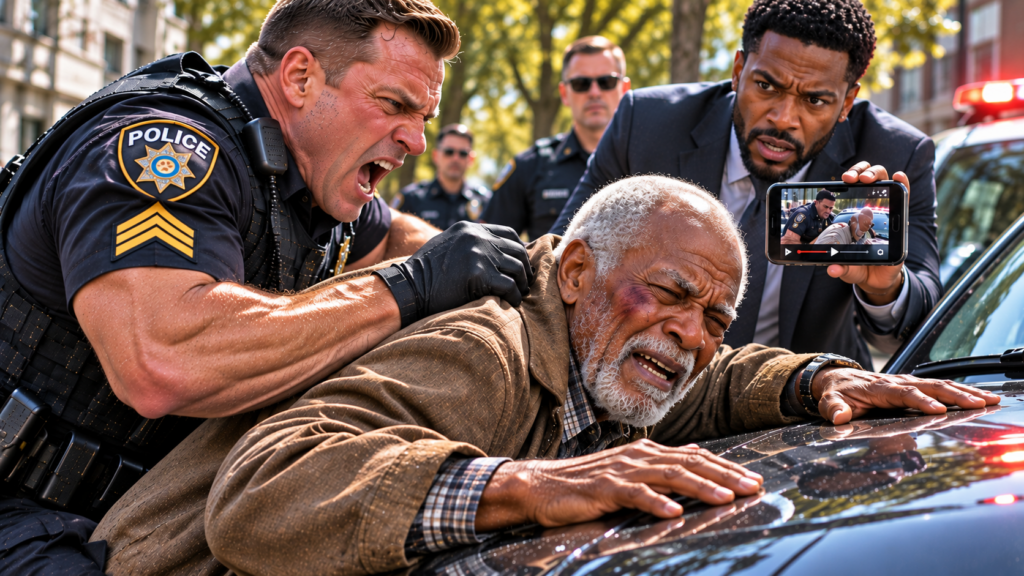
“Sergeant, let him go.” Deputy Elise Navarro heard the difference in her own voice. It was no longer a suggestion she could pretend had been misunderstood. Sergeant Thomas Baird turned without releasing Samuel Bennett’s collar. “Stay in your lane, Deputy.” The old Black man’s knees bent, and the sergeant hauled him upright again. His left shoe dragged across the concrete. Navarro stepped closer, her shoulder camera still recording. “His hands are empty. I’m calling medical.” She used her radio before Baird could order her not to. Across the street, Mrs. Holloway stood behind her screen door. She had known Samuel for twenty-three years. She had never seen him raise his voice at anyone but squirrels. Now she heard him trying to explain that his chest hurt. A white service van turned into the street and stopped abruptly. Marcus Bennett got out with his work badge twisted backward. His lunch bag fell beside the front tire. “Dad?” Baird looked toward him as if another problem had arrived. “Stay back. This is an active investigation.” Marcus saw his father’s shirt, the crooked collar, the grayness around his mouth. He stopped several yards away and raised both hands. “He takes heart medication. Please sit him down.” “Your father is resisting arrest.” Samuel tried to turn his head. “Marcus, I didn’t—” “I know, Dad. Don’t talk. Just breathe.” Navarro moved beside Samuel and supported his right arm. This time, when she asked Baird to release him, she did not wait. She helped the old man sit against the low garden wall. Baird stepped away, breathing hard from an effort nobody else had required. “There’s stolen equipment in that truck,” he told Marcus. “A generator. We have the owner’s report.” Marcus looked at the gray pickup near the garage. Then he looked at the generator strapped beneath its weatherproof cover. “That generator?” “You need to back away.” Marcus took out his phone slowly, announcing what he was doing. “I have something you need to see.” “I don’t need a lecture from you.” “It isn’t a lecture.” He opened an app and selected a recording from the previous afternoon. A familiar black patrol SUV appeared on the small screen. Its driver backed carefully toward Samuel’s garage. Baird himself climbed out and opened the vehicle’s rear compartment. Beside him stood the generator he now called stolen. Marcus turned the screen toward Navarro. From the speaker came Baird’s unmistakable voice. “Mr. Bennett, I need you to do a little repair job.” For the first time since arriving, the sergeant said nothing. Twenty hours earlier, Samuel had been pruning the climbing roses. His late wife had planted them when the neighborhood was mostly construction dust. Ruth believed every house needed something living that refused to behave. Samuel had kept the roses and never learned to argue with them. The shears were stiff in his fingers that afternoon. He had been an electrician for thirty-nine years, mostly in county maintenance. His hands remembered work more easily than they managed buttons now. When Baird arrived, Samuel put the shears on the porch rail. The sergeant greeted him by name. People sometimes assumed that meant friendship. In Bellweather County, Georgia, it usually meant somebody needed a favor. “We’ve got a generator for the community workshop,” Baird said. “Won’t hold a load. They tell me you’re still the man.” Samuel glanced toward the covered workbench in his garage. “I don’t do paid county jobs anymore.” “Just a quick look. For the kids.” The workshop served students who wanted to learn practical repair skills. Samuel had volunteered there before Ruth’s illness made evenings difficult. He asked who had authorized the work. “Pike Equipment handles the loan. I’ll bring the paperwork tomorrow.” Baird smiled as though tomorrow were a guarantee printed on an official form. They lowered the generator from the SUV using a small loading ramp. Samuel noticed a scraped patch beneath its newer identification sticker. “Old tag come off?” “Something like that. These things get moved around.” He said it too quickly, but Samuel had no reason to hear a warning. The sergeant wore a uniform Samuel had spent a lifetime trying to respect. Samuel agreed to inspect it without replacing anything expensive. Baird asked for a written service note stating the machine had arrived last month. Samuel looked up from the handle. “It arrived today.” “Just for the office. Their dates are a mess.” “Then they can fix their dates.” For a moment, the afternoon seemed to lose its warmth. Baird studied the porch, the pickup, and the half-open garage. “Always by the book, aren’t you?” “It’s easier than remembering two versions.” The sergeant laughed without showing his teeth. He left the generator and promised to return before noon. Samuel photographed the damaged label so he could ask about replacement parts. He sent the picture to Marcus with a complaint about modern stickers. Marcus replied from the transit depot between two electrical repairs. Ask for the real serial before you order anything. Samuel wrote the visible number in his old maintenance notebook. Then he moved the machine onto the pickup’s open bed for easier access. He had no reason to hide it. Before going inside, he waved toward the porch camera Marcus had recently installed. “Your mother would have called that thing nosy,” he said to nobody. The camera stored the remark along with everything else. At dinner, Samuel set two forks out before remembering he needed one. The camera had been Marcus’s idea after Samuel fell near the steps. Samuel disliked the proposal until his granddaughter changed the subject. “Grandpa, point it at the roses. Then I can check on them.” Eva was nineteen and studied biology two hours away. Ruth had taught her the names of plants before the names of television characters. Samuel agreed to a camera that faced the driveway and garden entrance. Marcus adjusted its boundaries so it did not peer into neighboring windows. It recorded locally and saved selected events to an account Samuel controlled. For three weeks, it had mostly documented delivery drivers and squirrels. Then Baird returned at nine thirty the next morning. Samuel was already waiting beside the pickup with his notebook. “This serial isn’t what the outer sticker says,” he began. Baird did not take the offered photograph. “I’ll need you to open the garage.” “Why?” “Equipment was reported stolen from Pike’s yard.” Samuel glanced toward the generator as though it might answer for itself. “The equipment you brought me?” “Don’t make this difficult.” Baird’s radio crackled. A second patrol vehicle stopped behind him. Navarro approached carrying a small notebook and an ordinary expression. “Morning, sir. We’re following up on a property complaint.” Samuel explained about the workshop and the delivery. Baird interrupted before he reached the request to alter the date. “Open the garage, Mr. Bennett.” “Do you have something saying you can search it?” It was a question Marcus had told him he was allowed to ask. Baird’s expression hardened as though the words themselves were an insult. “You refusing to cooperate?” “I’m asking what this is.” He reached toward his shirt pocket for his reading glasses. Baird caught his wrist and pulled him away from the truck. The first impact knocked the glasses onto the driveway. By the second, Samuel could no longer form a complete sentence. Inside the house, his phone rang unanswered on the kitchen table. Marcus was calling to ask whether the real serial had been found. When the camera alert appeared, he opened it absentmindedly at a traffic light. He saw his father’s empty hands and the uniform gripping his shirt. He pulled into a safe parking area and called emergency dispatch. He gave the address, described the situation, and said medical help was needed. Then he drove the remaining four blocks without remembering the route. Now he stood in the driveway with yesterday’s recording in his hand. Navarro watched Baird unload the same generator named in the complaint. “Send that to the investigator,” Baird said abruptly. Marcus looked at his father sitting against the wall. “I’d like medical to reach him first.” Sirens sounded at the far end of the street. Baird reached toward the phone. Navarro stepped between them. “Leave it in his hand, Sergeant.” The ambulance crew carried their equipment past a silence nobody had ordered. Samuel tried to apologize for the trouble. A paramedic named Avery crouched beside him. “Sir, you don’t have to make this easier for anybody.” The words nearly undid Marcus. He stepped back so the crew could assess his father. Navarro radioed for a supervisor and described a disputed use of force. Baird demanded that she speak to him away from the civilians. She kept the radio near her mouth. “Medical is treating Mr. Bennett. We need another supervisor here.” Across the street, Mrs. Holloway came down her steps wearing slippers. She carried Samuel’s reading glasses in a clean kitchen towel. One lens had split near the rim. “I heard him ask why,” she told Navarro. “Then I heard him asking to breathe.” The deputy wrote her name and contact information. Baird walked toward his vehicle, then stopped when Marcus spoke. “Yesterday, did you bring that machine here for a repair?” “I’m not discussing an investigation with you.” “You discussed it on my father’s porch.” Marcus did not raise his voice. He could hear how close he was. A lieutenant arrived with his uniform collar crooked from a hurried departure. His name was Dennis Heller, and Baird relaxed when he saw him. They spoke quietly near the second patrol car. Navarro remained beside the ambulance until Heller called her over. Marcus could not hear the conversation, only see her shake her head. Then she pointed toward her body camera. Heller looked at it, and his posture changed. Avery asked Marcus which hospital his father normally used. Samuel answered before he could. “Whatever’s nearest. I don’t want to be a bother.” Marcus put his hand over his father’s trembling fingers. “You’re allowed to take up space, Dad.” As the stretcher lifted, Samuel looked toward his open garage. “The notebook,” he whispered. “I’ll get it.” “Don’t let them say I wrote the wrong date.” Marcus felt something cold settle beneath his fear. He promised only what he could control. “I’ll keep what you wrote.” Navarro approached before the ambulance doors closed. She provided an incident number and said another investigator would contact them. Marcus asked whether his father was under arrest. “Not at this time,” Heller answered from behind her. The phrasing made a paramedic glance up. Marcus climbed into the ambulance instead of arguing over it. Through the rear window, he watched his father’s house shrink between uniforms. On his phone, the recording remained paused on Baird’s outstretched hand. The generator sat between the two men in yesterday’s sunlight. It looked ordinary, which made the lie feel worse. At the emergency department, Marcus filled out forms with a shaking pen. A nurse took over when he wrote his own birth date twice. Samuel was being assessed, and nobody gave Marcus a dramatic promise. They told him what they were checking and when to expect an update. He appreciated every sentence that did not pretend certainty. Eva called from the highway after his brief message reached her. He told her to pull over before explaining more. She went quiet in a way that sounded terribly like Ruth. “I’m coming,” she said. “Drive safely. He’s getting help.” When Marcus was allowed into the room, Samuel looked smaller beneath hospital blankets. The monitor beside him made every pause feel borrowed. “They think I’m a thief,” Samuel said. Marcus pulled a chair close enough that his father could see him easily. “I saw the video. I know what happened.” “Your mother wouldn’t have believed it.” Marcus thought about that, then answered honestly. “She would have believed you.” Samuel closed his eyes, and the distinction seemed to matter. In the corridor, Marcus called Denise Walker, an attorney recommended by a colleague. She asked about Samuel’s condition before asking about the recording. Then she gave Marcus a short list of things he could do safely. Preserve the original files. Keep the device. Write down the timeline. Do not rely on a social media upload as the only copy. Marcus returned home that afternoon while Eva stayed at the hospital. Mrs. Holloway waited on her porch until he arrived. She gave him the broken glasses and the notebook from the driveway. “I didn’t touch anything else,” she said. “Thank you for watching.” “I should have come out sooner.” Marcus had no energy to settle that question for her. “Tell the investigator what you saw. That’s something you can still do.” Inside, Samuel’s lunch waited beneath a plate on the kitchen counter. A tomato sandwich. Half an orange. A folded paper towel. Marcus gripped the counter until the room stopped moving. Then he disconnected the camera’s storage card and made working copies. He preserved yesterday’s delivery and the entire encounter that morning. He also saved messages, photographs, alerts, and the settings information. Denise arranged to collect the materials through a documented process. Before leaving, Marcus found Samuel’s pen beneath the truck. It was an inexpensive blue pen with a county maintenance logo. Samuel had used the same kind for decades. Marcus put it beside the notebook rather than in his pocket. The first public statement appeared on the department’s website that evening. It described a stolen-property inquiry and an elderly subject’s medical complaint. It said deputies had acted after encountering resistance. No officer was named. No delivery was mentioned. Eva read it aloud at the hospital, then stopped halfway through. Samuel watched her face instead of the screen. “That isn’t what happened,” he said. Denise arrived at the hospital the next morning with a plain canvas bag. She did not begin by promising a fortune or a television interview. She asked Samuel whether he wanted Marcus and Eva in the room. “Yes,” he said. “I don’t want to keep saying it alone.” She let him describe the previous afternoon before discussing the driveway. Samuel remembered the request to change the date with particular clarity. He had spent his working life writing down when things arrived and left. A machine with a bad bearing could wait. A bad record followed people. Denise asked where the notebook was. “With the copies,” Marcus said. “I kept the original untouched.” She nodded and turned back to Samuel. “Did Sergeant Baird give you any receipt or work authorization?” “No. He said he’d bring one.” “Did you ask him to deliver the generator?” “No.” “Did you move it off your property at any time?” Samuel shook his head and looked ashamed of having so few answers. Denise put down her pen. “You don’t have to know why he did this to describe what he did.” Later, outside the room, Marcus showed her the department’s statement. She read it carefully, including the time it had been posted. “We’ll ask them to preserve the records and correct factual errors.” “What if they don’t?” “Then their refusal becomes part of what we address next.” Marcus wanted something faster than a sentence built from patient verbs. Denise understood without pretending she could change time. “Your father’s health comes first. The evidence doesn’t need you to be reckless.” She contacted the sheriff’s office and the independent state investigative unit. Her letters identified the recordings and requested preservation of additional material. That included dispatch records, body-camera files, vehicle recordings, and the property complaint. She asked who currently held the generator and where it had been taken. By afternoon, Sheriff Colleen Ward called Marcus directly. She expressed concern and asked to visit Samuel privately. He told her all contact should be arranged through Denise. The sheriff accepted that answer, although she sounded surprised by it. Eva returned to the room carrying a bag of her grandfather’s clothes. She had chosen his soft blue shirt instead of the torn plaid one. Samuel touched the sleeve before asking about her lectures. “I emailed my professors.” “You shouldn’t miss school because of me.” “Grandpa, I’m here because of somebody else.” He looked away toward the window. For most of his life, he had made a virtue of requiring little. Now even comfort felt like a bill other people might have to pay. Eva sat beside him and opened her laptop. She showed him photographs of seedlings from her biology project. They spent twenty minutes debating which one she had overwatered. When the nurse returned, Samuel was speaking in full sentences again. Marcus stood in the doorway and let the ordinary argument continue. He had never been so grateful to hear his father disagree. Navarro completed her incident report before the end of her shift. She described Samuel’s empty hands, his statements, and Baird’s grip on his collar. She recorded when she had requested medical help and when it arrived. She did not write that he had resisted when she had seen no resistance. Lieutenant Heller called her into his office after reading the draft. “You’re missing context,” he said. “Which context?” “Baird had information about a theft.” “That doesn’t change what happened in front of me.” Heller leaned back and looked at her for a long moment. “Twenty years in this job. Think about what you’re suggesting.” Navarro thought about Samuel’s shoes dragging across the driveway. “I’m describing what I observed.” Heller returned the report with requests for clarification rather than an explicit order. She answered each request and retained the system’s version history. Then she submitted a separate memorandum about the disputed delivery recording. She notified the designated internal investigator that her camera had remained active. When she reached the parking lot, two coworkers stopped talking. One turned away. The other gave her a tiny nod. Neither response made the walk to her car feel safer. At home, her father was preparing dinner in a dented saucepan. He had retired after twenty-six years driving municipal buses. Elise told him only what she could discuss appropriately. He listened without interrupting and turned down the heat. “Did you stop him?” he asked. “Not fast enough.” He let the answer stand instead of cleaning it up for her. “Then tell that part too.” That night, Baird sent her a message from his personal phone. You’ve made a complicated situation worse. We need to talk. She saved it and declined the private conversation. By morning, the sheriff had assigned Baird to administrative duties pending review. The department called that a precaution rather than a finding. It was both less than Marcus wanted and more than Baird expected. Heller told Navarro she would work desk duty temporarily as well. He said the arrangement protected everybody while facts were gathered. She asked for the reason in writing. His expression changed as if she had learned an unwelcome new language. Meanwhile, a state investigator named Adrian Cole arrived to collect records. He requested Navarro’s original account before any further revisions. She gave him the report, the memorandum, and the message from Baird. Cole asked whether she had encountered similar behavior previously. Navarro felt the question settle where she had tried not to look. There had been sharp words. Rough handling. A complaint she had called unclear. She could no longer arrange them into unrelated incidents as easily. “I need to review what I reported,” she said. Cole waited. “And what I should have reported.” He wrote that down without praising her. For the first time, she was grateful he did not. Samuel came home on a Friday, moving carefully between Marcus and Eva. The doctors had explained his follow-up care and the symptoms requiring urgent attention. Marcus wrote the instructions down rather than trusting frightened memory. The house smelled of lemon cleaner and the soup Mrs. Holloway had delivered. Somebody had repaired the porch step while they were away. Samuel noticed immediately. “Who did that?” “Mr. Alvarez next door,” Eva said. “He said the step was annoying him.” Samuel nodded at the excuse, accepting the kindness inside it. Then he saw the driveway through the front window. His fingers tightened around the discharge envelope. Marcus waited without asking whether everything was all right. Everybody in the room knew it was not. That evening, Samuel asked whether the police would return for his truck. Denise had confirmed it had not been impounded. The generator had been taken into evidence, with its custody documented. His garage remained his own, but he looked at it as though it did not. Marcus offered to sleep in the downstairs guest room. Samuel said there was no need, then asked whether he had brought pajamas. Neither man pointed out the contradiction. After midnight, Marcus heard a cupboard door open and close. He found his father in the kitchen searching for a glass already in his hand. “I heard a car,” Samuel said. “It’s gone past.” “I know.” Marcus turned on the small light over the stove. When he was a boy, Samuel had done the same during thunderstorms. They sat at the table with water neither wanted. For a while, the refrigerator did the talking. Then Samuel spoke about his own father in rural Georgia. “He taught me to answer politely. Keep your hands where people can see.” Marcus looked at the bruising above his father’s wrist. “You did.” “I thought if a man knew me, that would count for something.” “It should have.” Samuel’s mouth trembled, and he covered it with his uninjured hand. He had cried when Ruth died, but always behind a bathroom door. Now there was nowhere small enough to put the grief. Marcus moved his chair instead of telling him to be strong. “I was scared,” Samuel whispered. “So was I.” “I thought I was going to die in my own driveway.” Marcus held his father’s hand and let the sentence remain true. They did not soften it into misunderstanding or a difficult morning. At two, Samuel finally returned to bed. Marcus stayed awake until he heard steady breathing through the open door. On the kitchen table lay the broken glasses in their towel. He considered throwing them away, then left them where Denise could collect them. His father deserved new glasses. He also deserved a record of why the old ones had broken. The first reporter to call wanted Marcus to reenact finding his father. He ended the conversation before she finished describing the shot. The second asked whether Samuel had ever been arrested. Marcus told Denise he was finished speaking to reporters entirely. She suggested they make the decision with Samuel rather than for him. Two days later, local journalist Lila Grant sent a different request. She had obtained the initial incident statement and noticed a timeline problem. The property complaint had been entered after Baird was already en route. She wanted to know whether the family had relevant documentation. She did not ask for access to Samuel’s hospital room. Denise arranged a conversation at her office after discussing boundaries with the family. Samuel attended in person, carrying his notebook in a grocery bag. He placed it carefully between Lila’s recorder and her cup of coffee. “This is what I wrote before he came back,” he said. Lila asked whether she could examine it and photograph selected pages. Then she listened to the story without trying to improve its wording. When Samuel forgot a time, she marked it as approximate. When Marcus supplied one, she asked what supported his recollection. He liked her more every time she slowed him down. They showed her the delivery recording and the complete driveway encounter. Lila asked about the unfamiliar serial number beneath the replacement sticker. Samuel turned to a page near the back of his notebook. “It looks like an old county asset mark. I can’t swear it’s ours.” “Why do you recognize it?” “Because I used to write them down.” He explained the maintenance system used before his retirement. Some portable machines had a stamped identifier underneath later inventory labels. It helped track equipment when weather destroyed the outer stickers. He had photographed a number partly hidden under the generator’s frame. Lila enlarged the picture, careful not to mistake pixels for certainty. She wrote down the visible characters and requested the relevant county records. Marcus expected the story to appear that afternoon. Instead, Lila called Baird’s representative, the sheriff, and Pike Equipment. She gave them a clear deadline to respond to specific questions. Ben Pike said he had never authorized Baird to loan out company property. The sheriff’s office said the matter was under independent review. Baird’s representative called the family’s interpretation incomplete and misleading. Lila included those responses rather than pretending the video answered every question. Before publication, she checked how much medical detail Samuel wished to disclose. “Enough that people know I wasn’t pretending,” he said. They agreed on a brief description without publishing his private records. The article appeared Sunday morning beside images of both generator labels. Its opening sentence described an officer reporting property stolen after delivering it himself. The video played without dramatic music. At the kitchen table, Samuel read every word slowly through temporary glasses. He paused on his own name, spelled correctly. Then he folded the printout beside his plate. “I would like to go outside today,” he said. Marcus looked toward the driveway and stood up. They went together, leaving the front door open behind them. By Monday, the recording had escaped the county and become everybody’s argument. Some viewers demanded Baird’s arrest before any investigator could interview him. Others called Samuel an actor and Marcus a technician who could fabricate anything. A stranger posted a photograph of their house with its street number visible. Lila removed the identifying detail from her own comment section when alerted. She could not pull it back from the rest of the internet. Denise helped the family report direct threats and document unwanted contact. Marcus changed their public contact information and checked the camera coverage. He explained each change to Samuel before making it. The old man had lost enough control over his own house. At work, Marcus found an envelope beside his locker. Inside was a collection from colleagues to cover meals and transport. He tried to refuse until his supervisor told him it wasn’t a vote. “Your dad fixed my mother’s porch light for nothing,” she said. “Let us buy the man dinner.” He sat on the bench until he could read the card properly. Meanwhile, the sheriff called a press conference. She said the initial statement had relied on preliminary information. She confirmed that Baird was now on administrative leave. She did not announce findings before the independent review was complete. A reporter asked why the department had described resistance so quickly. The sheriff looked down at her prepared notes. “We should have been more careful about what we stated as fact.” It was not everything, but Marcus heard the admission. Baird’s supporters organized a gathering outside a local diner that evening. Some brought photographs from past rescues and charity events. Samuel recognized a picture of Baird carrying a child away from floodwater. “That was a good thing he did,” he told Eva. She looked at him, surprised and angry. “It doesn’t change this.” “I know. People can do a good thing and still owe for another.” Eva sat down beside him instead of arguing with a position he did not hold. Across town, Cole reviewed the original files from the porch camera. A specialist examined their source, timing, and continuity alongside other records. The delivery appeared in a neighbor’s driveway camera as well. A passing school bus camera placed Baird’s vehicle on the street that afternoon. None of those sources alone told the entire story. Together, they made a fabricated delivery increasingly difficult to claim. Cole obtained the original property complaint submitted by Pike Equipment. Its attached serial matched the replacement sticker, not the mark beneath it. The complaint described a machine taken from a locked storage yard overnight. Yet the delivery recording placed it with Samuel before that reported loss. Cole underlined the discrepancy and requested the yard’s inventory records. Pike’s lawyer replied that the business would cooperate through appropriate channels. The reply contained no explanation for the dates. That evening, Lila called with a question for Samuel. Did he remember an old pumping station on Everett Road? Samuel looked toward the notebook before answering. “Yes,” he said. “I maintained the backup equipment there.” Then he asked Marcus to bring down the box from the hall cupboard. The box contained retirement cards, maintenance journals, and photographs of muddy worksites. Samuel had meant to sort it after Ruth’s funeral. Instead, it had become another cupboard holding an unfinished part of their marriage. Marcus carried it to the table and waited while his father opened it. The journals were personal field notes, not a secret archive of official records. Samuel had used them to remember repairs before completing county paperwork. He found Everett Road beneath a drawing of a faulty fuel valve. Beside it was a stamped asset number with the same visible characters. He did not declare the mystery solved. He called Denise and explained what he had found. She arranged for Cole to inspect the original journal and photographs. The county’s own records would have to confirm the identification. Within days, they did. The generator had served the Everett Road pumping station for years. It had later moved to a storage facility awaiting reassignment or authorized disposal. Pike Equipment had purchased several older machines at a county auction. This particular generator was not included on that sale’s final asset list. Its replacement sticker corresponded to a different machine of similar size. Cole requested the warehouse checkout records and associated vehicle access logs. Baird’s name appeared on an equipment movement form for a community preparedness event. The event coordinator could find no corresponding generator delivery. She had assumed the promised machine was unavailable and rented one elsewhere. Samuel listened to these developments through Denise rather than scattered online claims. He found some of it difficult to follow until one phrase caught him. “Disposed as uneconomical to repair.” He asked whether anybody had actually inspected the machine before that classification. The records included a repair estimate on Pike’s letterhead. It described a failed internal component Samuel had found working normally. His own brief inspection had identified a smaller, inexpensive fault. Cole asked whether Samuel would be willing to explain that observation formally. “I won’t say more than I tested,” he replied. “That is exactly what we need.” Later, Marcus helped him review the messages on his old phone. They found one Samuel had sent Baird early on the morning of the encounter. The old county mark is under the sticker. Please confirm authorization before I work. Baird had read it minutes before calling dispatch. Samuel stared at the screen, trying to remember pressing send. “I thought he might have brought the wrong one.” Marcus understood then why the visit had felt less like an investigation. Baird had not arrived to learn what Samuel knew. He had arrived after learning Samuel knew something inconvenient. That was a theory, Denise cautioned when Marcus said it aloud. The messages supported questions investigators still needed to answer. He wrote the distinction down because anger made certainty feel tempting. At dinner, Samuel reached for the salt and winced at his shoulder. Marcus moved it closer without commenting. The paperwork was becoming clearer, but his father’s pain did not read paperwork. After the meal, they put the journals in separate protective sleeves. Samuel kept one retirement photograph out of the box. It showed him laughing beside a machine somebody else had called beyond repair. Lila’s next article prompted a crowded county commission meeting. People who had ignored Samuel’s name paid attention to missing public equipment. Marcus found that infuriating until Denise reminded him both questions mattered. The public’s money could open records that the public’s conscience had left closed. Samuel decided to attend, though he did not promise to speak. Eva drove because headlights still made him uneasy after sunset. Inside the meeting room, somebody had placed folding chairs along the walls. A man wearing a support sticker for Baird looked at Samuel, then away. Samuel chose a seat near the exit without apologizing for it. The county administrator described an audit of equipment disposal and repair invoices. An outside firm would compare inventory, sale documents, and physical assets. A commissioner asked whether the affair was becoming a personal campaign against officers. Samuel felt Marcus straighten beside him. He put a hand on his son’s sleeve. When public comment opened, Samuel stood with his notebook. He walked slowly, accepting the microphone rather than gripping the lectern. “I worked for this county longer than some of you have been alive.” A few people smiled before recognizing he was not making a joke. “I wrote numbers down because the next person needed to trust them.” He looked toward the administrator, not the cameras at the back. “If a machine is broken, fix it. If a record is wrong, correct it.” His hand trembled, and the microphone amplified a small breath. “Don’t call a man a thief because he asks which one you’re doing.” He returned to his seat before the timer sounded. Marcus had prepared himself to defend his father from an interruption. He had not prepared himself to feel so proud he could barely look at him. Afterward, a woman approached carrying a yellow envelope. Her name was June Ellis. Her father had repaired lawn equipment locally. Two years earlier, he had been questioned about county-owned tools at his shop. She said Baird had brought them there before returning with accusations. The matter had ended without charges after the tools were surrendered. Her father had stopped volunteering soon afterward. Samuel recognized the man’s name before recognizing the pattern. “He fixed the church mower every spring.” June nodded. “Until he was afraid to let anyone leave anything.” Denise gave her a contact number and suggested sharing her records privately. She did not promise that their experiences were identical. Over the following week, two other families contacted the state investigators. Not every account could be corroborated. Some details differed. Some dates were uncertain. One rumor proved entirely false. Cole treated those differences as reasons to investigate rather than reasons to stop. The audit found discrepancies in several disposal entries bearing recurring names. Some equipment had been sold correctly. Some lacked necessary supporting records. A few machines appeared under more than one identity in separate lists. For the first time, the inquiry extended beyond Samuel’s driveway. Baird’s representative said administrative mistakes did not establish criminal intent. Lila printed that response beside the documented discrepancies. Samuel read the article, then called June to ask about her father. The man had died the previous winter without seeing the records reviewed. That evening, Samuel put another chair out on the porch. The chair was for Walter Greene, Samuel’s oldest friend from county maintenance. Walter arrived carrying peaches and the particular anger of a careful man. He listened while Samuel described June’s visit after the meeting. Then he looked toward the empty space where Ruth’s rocking chair had stood. “She’d tell you to eat something before changing the world.” Samuel smiled, though the smile did not last. “I don’t want to change the world. I want my mornings back.” Walter nodded as though that were a sufficiently large ambition. For a while, they discussed irrigation, weather, and a neighbor’s ambitious extension. Then Walter asked why Samuel had stopped attending their Saturday breakfast. Samuel looked down at the bruising fading near his wrist. “People keep wanting to talk about it.” “Then we’ll tell them not to.” “It doesn’t work that easily.” “No. But breakfast is worth a first attempt.” Inside, Marcus read another message requesting his participation in a television interview. He had begun measuring usefulness by how much attention something could attract. He did not notice the change until he interrupted the porch conversation. “Dad, there’s a network willing to come here tomorrow.” Samuel looked tired before Marcus finished describing the opportunity. “No.” “They could put pressure on the county.” “I said no.” Walter busied himself with the peach bag, giving them what privacy he could. Marcus felt frustration rise beneath his fear. “We can’t let them wait until everyone forgets.” Samuel looked directly at him. “I’m not everybody, son. I’m right here.” The words stopped Marcus more effectively than shouting would have. He sat on the porch step and put the phone away. “I thought I was helping.” “You are. But I can’t live as evidence every hour.” Marcus looked toward the camera above the door. For weeks, it had seemed like the only reason anyone believed them. Now he understood how easily protection could become another kind of watching. That night, he apologized without asking Samuel to reassure him. They agreed on times for case updates and on conversations that could wait. Denise would filter requests. Samuel would decide which interviews he wanted. Marcus would stop reading public comments aloud as though his father owed replies. On Saturday, Walter collected Samuel for breakfast at seven thirty. The waitress brought coffee, looked at Samuel’s shoulder, and asked about the roses. He answered for ten uninterrupted minutes. When he returned, he carried a paper bag containing Marcus’s favorite biscuit. Neither man mentioned the television crew again. In the afternoon, Cole called Denise about a new development. Records obtained from Pike Equipment included exchanges about Samuel’s inspection. The messages had been preserved before either man knew about the porch recording. Their contents required another interview with Samuel. This time, Marcus asked whether his father wanted to hear about it immediately. Samuel finished watering the roses before saying yes. The messages did not read like speeches written for villains. They concerned invoices, pickup times, money, and somebody being difficult. That ordinary language made them harder for Samuel to stomach. Pike had complained that a pending inventory check could expose mismatched equipment. Baird had replied that he knew retired repairmen who could supply service paperwork. Samuel’s name appeared in an exchange about backdating a receipt. Later came a photograph of the generator inside Baird’s patrol SUV. The next morning’s messages referred to the stamped number Samuel had noticed. He’s asking county questions, Baird had written. Pike’s reply arrived before the call to dispatch. Then get it back before he sends pictures around. The messages did not explicitly order a fabricated theft complaint. Other records showed who submitted it and when. Investigators assembled the sequence rather than asking one sentence to prove everything. Samuel listened to Denise’s careful summary, then looked toward Marcus. “They could have asked for it back.” It was the question at the center of everything. No stolen-property accusation had been necessary to collect an unfinished repair. No grip on the collar. No impact against the car. Baird had chosen the authority of an arrest over the embarrassment of an explanation. Cole also obtained payment records between Pike and an account linked to Baird. Their stated purposes did not match the work investigators could verify. Several transfers aligned with disputed equipment movements. Baird’s lawyer offered alternative explanations, which the investigators examined. Some transactions had legitimate supporting documents. Others did not, and the distinction remained in the investigative report. At the sheriff’s office, Heller was interviewed about the original public statement. He acknowledged relying on Baird’s account before reviewing Navarro’s complete recording. He had described Samuel as resistant because that was the characterization supplied. Asked why he pressed Navarro to revise her narrative, he cited consistency. The investigator asked whether consistency should come before accuracy. Heller requested a break. Sheriff Ward learned that her communications staff had published language she had approved. She could not distance herself by pointing at the draft’s author. At her next public briefing, she said so. “I authorized a statement that went beyond what we had verified.” A reporter asked whether she intended to apologize to Samuel personally. “I have offered through his attorney. He decides whether to receive me.” Samuel watched the briefing from his living room without answering aloud. He had never expected an elected official to say he could refuse. The following day, he asked Denise to arrange a meeting with conditions. Marcus would attend. No photographers. No request to forgive the department. The sheriff agreed. When she arrived, Samuel offered her the chair beside Walter’s. He listened to her apology without making it easier for her. Then he asked whether Navarro was still on desk duty. “Yes,” Ward said. “That assignment is being reviewed separately.” “Review it honestly,” he replied. “Including why she didn’t stop him sooner.” The sheriff nodded and wrote the sentence down. Samuel noticed that she used her own pen. Navarro received notice of a formal review of her response. Some colleagues called it punishment for speaking out. She knew the truth was more uncomfortable than that. She had spoken out, and she had also waited while Samuel was hurt. Both things could be true without canceling each other. Her representative advised her to describe the timeline precisely. She did not add a heroic memory of intervening before she had. She explained the orders, the hesitation, and the moment she recognized the danger. Then she described earlier occasions when she had softened concerns about Baird. One involved an older man stopped outside a hardware store. Another involved a complaint she had categorized as a communication problem. She had believed experience gave Baird knowledge she lacked. Now she understood how often that belief had saved her from choosing. The review required further training and documented failures in her initial intervention. It also recognized her subsequent actions and truthful reporting. The desk assignment ended after the necessary process, not as a ceremonial reward. She returned to fieldwork under closer supervision and accepted the conditions. At home, her father asked how she felt. “Like I don’t get to call myself the good one and stop thinking.” He passed her a bowl of rice. “That sounds useful.” Weeks later, Samuel agreed to meet her in Denise’s office. Navarro arrived without flowers, gifts, or a request for a photograph. She described what she wished she had done earlier. She did not ask him to agree that she had tried her best. Samuel watched her hands clasped tightly in her lap. “You stayed truthful when it got difficult,” he said. “Yes, sir.” “It was difficult before that too.” Her eyes filled, but she did not make him manage the tears. “I understand.” “I hope you keep understanding when nobody’s filming.” After the meeting, Samuel sat in the parked car for several minutes. Marcus waited with the engine off. “Do you feel better?” he asked eventually. “A little. Not in the way people mean.” Samuel adjusted the seat belt away from his shoulder. “I don’t want her ruined. I want the next person protected sooner.” Marcus nodded and started the engine. That afternoon, the state investigators completed a substantial phase of their work. Their findings went to prosecutors responsible for deciding which charges to pursue. Denise warned the family that an investigation and a prosecution were different stages. There could be additional delays, contested evidence, and decisions they could not control. Samuel asked whether he would need to testify. “Possibly,” she said. “We’ll prepare if that happens.” He looked at the hands resting on his knees. He had spent months hoping the recording could speak instead of him. Now he understood that a video could show harm without carrying all its weight. “If they ask me,” he said, “I’ll tell them what happened.” Marcus reached over and adjusted the air vent toward his father. Baird was arrested on a clear morning six months after the driveway encounter. The photographs showed no dramatic confrontation and no one pressed against a car. He walked between investigators wearing ordinary clothes and an expression Marcus recognized. It was disbelief that the rules could arrive at his own door. The announced charges concerned the force used against Samuel and the equipment scheme. Pike faced separate charges arising from records, property, and payments under investigation. Both men entered pleas denying wrongdoing, and the court process began. The prosecutor’s office explained the schedule to the family without promising speed. Samuel turned seventy-nine while motions and hearings filled the calendar. Eva came home with a cake shaped badly enough to become a family treasure. The icing generator on top looked more like a washing machine. Samuel laughed until his shoulder reminded him to stop. “Next year,” he told her, “just make a cake.” She took a photograph only after he nodded. The house had become better at asking permission. By then, Samuel had begun attending a support group for older adults after trauma. He disliked the first meeting and went back the following week anyway. A retired teacher described being afraid of a stairwell after a fall. A former nurse admitted she checked the door lock four times every night. Their experiences were different, but fear sounded familiar in all their voices. For once, Samuel did not have to explain why being home was complicated. Marcus attended a separate counseling appointment after Eva insisted he stop pretending. He admitted watching the driveway recording whenever he could not sleep. He told himself it was preparation, although nothing new appeared after midnight. The counselor asked what he hoped to find on the next viewing. Marcus had no answer until he reached the parking lot. He wanted the version in which he arrived sooner. That version did not exist, and watching could not create it. He moved the working copies out of his everyday phone gallery. The originals remained preserved where the legal team could access them appropriately. He started leaving his phone in another room during dinner. Sometimes he retrieved it twice before dessert. Sometimes he did not. In early spring, Pike sought a negotiated resolution through his lawyer. The discussions eventually produced an agreement requiring truthful cooperation and accountability. The judge would determine its final consequences under the court process. Pike provided records that helped explain how the labels had been exchanged. He admitted that the theft report had misrepresented the generator’s whereabouts. He did not claim Baird had forced every decision he himself had made. Baird continued to contest the accusations and chose to proceed to trial. A victim liaison asked Samuel whether he wanted to tour the courtroom beforehand. He accepted, bringing the notebook he no longer needed to carry everywhere. The empty witness chair looked smaller than it did on television. He sat in it, tested the microphone, and practiced asking for water. Marcus waited at the back rather than answering questions for him. When they left, Samuel looked toward the courthouse steps. “I thought being brave would feel different,” he said. Marcus considered the father who had repaired engines through summer heat. “Maybe it usually feels like doing the next thing.” Samuel took the railing and did that. The trial began on a Monday with rain ticking against courthouse windows. Baird sat beside his defense team, listening as the allegations were summarized. The judge instructed the jurors to decide from admitted evidence, not public reaction. Samuel appreciated hearing that, even though public reaction had kept him awake. He did not want a jury selected from people who already loved him. He wanted one prepared to see what had actually happened. The prosecution began with records rather than the most painful footage. The county inventory manager explained the generator’s original identification. The auction documents showed which machines Pike had legitimately purchased. The Everett Road generator was not among them. A warehouse employee described Baird collecting equipment for the preparedness event. The coordinator confirmed that no generator had reached the venue. Each witness supplied a smaller fact than the internet had demanded. Together, those facts built a path toward Samuel’s garage. Pike testified about altering labels and arranging questionable repair documents. The defense examined his agreement and the benefit he hoped to receive. The prosecutor acknowledged both instead of pretending cooperation made him innocent. Documents and messages supported parts of his account independently. Other details depended on his credibility, and the jurors heard that too. Then the camera evidence was introduced through the necessary witnesses. Marcus explained installing the porch camera and preserving the files after the incident. He described his work maintaining electrical systems for the transit service. He did not pretend that made him an expert in every digital question. A specialist addressed the technical examination and the supporting sources. The defense asked whether recordings could theoretically be altered. The answer did not turn into a promise that technology was infallible. Instead, the specialist explained the examination performed in this particular case. The delivery was corroborated by records and recordings from independent locations. No supported sign of the alleged fabrication had been found. The jurors watched Baird back into Samuel’s driveway in afternoon sunlight. They heard him ask for a repair and promise paperwork the following day. They heard Samuel refuse to write an arrival date that was not true. Nobody in the courtroom laughed when Baird called him a stickler. Marcus sat with his hands flat against his knees. He had watched the clip so often that every pause felt memorized. Yet hearing his father’s ordinary voice in that room still hurt. The defense suggested Baird could have believed the machine belonged to Pike. The prosecution did not need to deny every uncertainty to answer that. It presented the message Samuel sent about the county mark the following morning. It presented the exchanges between Baird and Pike before the property complaint. Then it returned to what Baird had told dispatch and written afterward. The accounts did not describe a repair delivery that had become a dispute. They described locating property in a suspect’s possession during an investigation. The missing explanation was not a minor difference of wording. At the afternoon break, Marcus found Samuel standing near a window. “Want to go outside?” he asked. “Not yet. I like being able to see the street.” They watched rainwater gather along the courthouse curb. For a few minutes, neither thought of a useful thing to say. They stayed together anyway. Samuel testified on Wednesday morning wearing the blue shirt Eva had chosen. His new glasses sat straight, though he adjusted them whenever he felt nervous. He described Baird’s first visit and the request to change the date. He explained that he had accepted the generator because he trusted the uniform. Then he corrected himself before the prosecutor asked another question. “And because it was supposed to help children. I wanted that to be true.” The admission made him sound human rather than perfectly prepared. He described asking for authorization and reaching for his glasses. He remembered the first impact more clearly than the second. He said so instead of filling the gap with what the recording showed. When asked why he had raised his hands, he looked at them. “I was trying to keep from falling. I couldn’t get enough air.” The defense asked whether he had been frustrated by the sergeant’s questions. “Yes.” “Did you refuse to do what he asked?” “I asked why he wanted to search my garage.” “That’s not quite what I asked, Mr. Bennett.” Samuel waited until the question was repeated in a form he could answer. He did not apologize for needing it clear. He acknowledged that he had not opened the garage on command. He denied striking, threatening, or attempting to flee from Baird. The footage supported what his memory could not describe second by second. Navarro testified after lunch, including the part she most wished to forget. She described recognizing the medical distress and hesitating before acting firmly. The defense asked whether she had concerns about her own employment review. “Yes,” she said. “That doesn’t change what I saw.” Her camera recording showed the period before Marcus arrived. It captured Samuel saying the sergeant had delivered the generator himself. It captured Baird ignoring the explanation and describing him as uncooperative. Then came the sounds the family had not wanted strangers to replay endlessly. The impact. The broken breath. Navarro’s first, insufficient warning. Samuel had chosen not to remain in the room for that portion. Eva sat with him outside, looking at photographs of their roses. Inside, Marcus kept his eyes on the screen without turning it into duty. When it became too much, he looked away. He was allowed to be his father’s son rather than another recording device. Baird’s defense presented witnesses to his work history and previous acts of service. The court did not dispute that those events had occurred. The question remained what he had done on this particular driveway. In closing, the defense argued that a difficult encounter had been misinterpreted. The prosecution asked the jury to compare that explanation with the complete record. The jurors were not asked to repair the county or settle every public argument. They were asked to decide the charges against one defendant from the evidence. Deliberations began late Thursday afternoon. The family ate dinner in a café where nobody recognized them. Samuel chose soup, then changed his mind and ordered fried chicken. Eva smiled at the small rebellion against hospital food that was months overdue. Marcus told a story about a bus that would not stop sounding its alarm. For several minutes, they laughed louder than the table required. The courthouse would still be there in the morning. The verdict came the following afternoon, after a question and further deliberation. Samuel stood slowly when the clerk asked the courtroom to rise. Marcus watched the jurors instead of Baird. The jury found him guilty on the central charges arising from Samuel’s mistreatment. It also returned guilty findings on substantiated parts of the property scheme. It did not convict on every allegation presented. The distinction mattered, even through the sound of Eva crying beside them. Samuel closed his eyes for a moment and then opened them. Across the aisle, Baird stared forward as though awaiting a different announcement. There was no speech from him and no instant transformation in his face. Marcus found that less satisfying than he had imagined and easier to bear. The verdict did not require the sergeant to understand it before it existed. Sentencing took place later, after the court received the necessary information. Samuel was offered an opportunity to describe the effect on his life. He wrote his statement at the kitchen table with the county-logo pen. He crossed out one sentence demanding that Baird feel what he had felt. He did not believe pain could be transferred that neatly. What remained was more exact. He described losing sleep, confidence, independence, and easy use of his own driveway. He described Marcus missing work and Eva learning to fear unanswered calls. Then he described what he wanted protected for the next family. “My age didn’t make me disposable. His uniform didn’t make him right.” He read the statement himself, stopping once to drink water. The judge imposed a prison sentence and other consequences tied to the convictions. Pike was sentenced separately for his admitted role in the equipment scheme. Their obligations did not end with public embarrassment or a change of jobs. Outside, reporters asked Samuel whether justice had finally been served. He considered the question before answering. “A decision has been made. Now I want to go home.” Denise guided further questions away without speaking over him. The civil case continued on its own track and later reached a resolution. It addressed documented harm and included enforceable changes to departmental practices. The terms were reviewed carefully rather than announced as a miraculous cure. Samuel used part of the recovery for treatment and the practical costs of healing. He set aside money for Eva’s education and kept the rest without apologizing. He did not owe the public a donation to prove he had deserved protection. The county recovered some equipment and revised its tracking of repairs and disposal. The audit’s unresolved items remained public instead of disappearing beneath the verdict. Heller received disciplinary consequences for his handling of the report and review. Sheriff Ward instituted outside checks on serious complaints and published response deadlines. Lila continued comparing the new promises with actual records. Some changes worked. Others required uncomfortable follow-up articles. Samuel read those on Sunday mornings beside the roses. He did not confuse one verdict with a finished responsibility. One evening, Marcus found him standing beside the gray pickup. The driver’s door was open, and the keys rested in his palm. “Want company?” Marcus asked. Samuel smiled and shook his head. “Not this time. I’m only going to get peaches.” Marcus stayed on the porch and watched his father leave on his own. By the next summer, the community workshop had reopened in a larger building. Samuel agreed to teach two mornings a month, with Walter handling the heavy lifting. He refused the suggestion that the program be named after him. Ruth’s Repair Table was his alternative, and nobody argued for long. She had never repaired an engine, but she had repaired more difficult things. On opening morning, Eva arranged safety glasses beside the benches. Marcus checked the wiring without finding a reason to keep checking it. The first students arrived carrying broken fans, radios, and enormous expectations. Samuel showed them how to label parts before taking anything apart. One boy wanted to skip the notebook and get to the interesting work. “The notebook is interesting,” Samuel said. The boy looked unconvinced, which Samuel considered a healthy beginning. He explained that a record helped the next person understand what had happened. “What if you make a mistake?” a girl asked. “Write down the correction. Don’t pretend the first thing was always right.” Navarro visited later in response to an invitation from the organizers. She brought no equipment for repair and asked where she could help. Samuel pointed to a stack of folding chairs. She carried them inside and listened while he finished the lesson. There was no ceremony making either of them simpler than they were. At noon, June Ellis arrived with her father’s old toolbox. She wanted the students to use it rather than leave it shut in a cupboard. Samuel recognized the worn red handle and stood quietly beside her. They put the man’s name on the inside lid. Nothing about the gesture recovered the years he had lost. It made room for something useful to follow them. Afterward, Marcus drove Samuel home past the courthouse and the repaired pumping station. His father pointed out a house with terrible drainage and another with excellent tomatoes. The observations were so familiar that Marcus nearly missed their importance. Samuel was looking at the neighborhood again instead of looking for danger. Not always. Not perfectly. But enough to notice the tomatoes. At home, he carried the empty lunch containers into the kitchen. Marcus stayed outside to collect a package near the porch rail. Above the door, the camera blinked its small, unremarkable light. For months, he had thought of it as the device that saved his father. Now he thought of Navarro choosing to act, and Mrs. Holloway remembering clearly. He thought of Denise’s questions, Lila’s patience, and Samuel’s stubborn dates. A recording had mattered because people had finally taken responsibility for what it showed. Inside, his father called him to help find the good plates. Eva was coming for dinner, and Walter had promised pie. Marcus left the package on the table and washed his hands. Through the window, he saw Samuel return to the garden with his shears. The old man bent toward a rose that had grown stubbornly across the path. He studied it, shook his head, and decided to leave it another day. Ruth would have approved of a little disobedience from a plant. Marcus took out his phone when the porch camera sent a routine alert. On the screen, his father stood in sunlight, waving Eva through the gate. No uniforms. No shouting. Just dinner waiting and somebody arriving home. Marcus smiled and put the phone away. This was a moment he could join instead of watch.