Beckett Callaway watched Vera Langston disappear through the humanities building doors.
He mistook the straightness of her shoulders for an invitation to test them.
Beside him, Tucker Reeves laughed at something that had not happened yet.
Mason Price stood a little farther away, turning his phone over.
He always looked uncomfortable before joining in, which never stopped him.
Inside, Vera found room 214 by following the numbers twice.
She had arrived early enough to choose a seat near the door.
Her father had taught her to notice exits without looking afraid.
Now she noticed them because sometimes a classroom felt like a trap.
The student beside her moved a backpack off the empty chair.
“You can sit here,” the girl said, although Vera already had.
They both smiled at the mistake, and the room felt less enormous.
“Leila Hassan. Journalism. Chronically early when I expect to get lost.”
“Vera. Same condition. Different major.”
“What major?”
“Engineering. If the scholarship office hasn’t changed its mind overnight.”
Leila pulled out two pens and offered her the better one.
It was a small kindness, which made Vera suspicious of crying.
She looked down until the feeling passed.
After class, Leila walked with her toward the student center.
Halfway across the courtyard, a football rolled deliberately into Vera’s ankles.
Beckett approached with the smile of someone accustomed to being forgiven.
“You’re the transfer. Ohio, right?”
Vera stepped around the ball. “Apparently the admissions office talks.”
“My mother chairs the scholarship foundation. People mention things.”
Leila’s expression changed before Vera understood why.
Beckett offered his hand, then withdrew it when Vera reached.
Tucker laughed from the steps. Mason pointed his phone elsewhere.
“Reflex test,” Beckett said. “You failed.”
Vera let her own hand fall without answering.
Back home, Danny would have waited until they were alone.
Then he would have asked what she had noticed before the joke.
Three boys, she thought. One audience. One person deciding the rules.
She had noticed enough.
“Come on,” Leila said, touching her elbow gently.
Beckett stepped into their path, still smiling.
“Westbrook’s friendly. You just need a sense of humor.”
“Then you should try being funny,” Leila said.
For the first time, his smile stopped looking effortless.
Vera walked away before he could borrow it back.
At the apartment, Eleanor had unpacked the kitchen and nothing else.
There were two bowls on the counter and soup warming slowly.
“Meet anyone?” her mother asked.
“A girl who lends pens. A boy who shouldn’t.”
Eleanor smiled, then looked at Vera more carefully.
“You don’t have to make everything sound smaller for me.”
Vera stared at the steam rising from her bowl.
“I know.”
That night she found her father’s photograph under a stack of towels.
She put it on the desk, facing the door.
By Thursday, someone had edited Vera into a campus welcome video.
Her outstretched hand froze beneath a caption calling her Scholarship Girl.
Tucker supplied the laughter. Beckett never appeared in the final frame.
Leila showed her before somebody else could enjoy doing it.
Vera watched once, returned the phone, and opened her mechanics textbook.
“You can be angry,” Leila said.
“I am. I’m also behind on chapter three.”
But the same paragraph followed her through lunch without becoming comprehensible.
In the library, a boy quietly placed a charger beside her laptop.
“You’ve got eight percent,” he said. “I’m at ninety.”
His name was Owen Brooks, and he worked the evening desk.
He recognized the textbook and explained a diagram without touching her notebook.
Vera liked that more than she expected.
When her phone vibrated, the diagram dissolved into another anonymous message.
Enjoy the free tuition while it lasts.
Owen saw her expression, although she turned the screen downward.
“You don’t owe me an explanation,” he said.
It was the first useful thing anyone had said all day.
She saved the message before deleting the notification.
That evening she called the campus student support office.
A coordinator named Ms. Pike offered an appointment the following Wednesday.
“Immediate physical danger?” the woman asked.
“No.”
“Then document everything and avoid engaging.”
Vera wrote the appointment into her calendar with her father’s old pencil.
At home, Eleanor sat surrounded by applications for bookkeeping jobs.
One employer wanted recent references; another wanted weekend availability without notice.
Vera nearly mentioned the messages, then noticed the overdue electricity envelope.
Instead, she asked whether her mother wanted tea.
They drank it beside boxes neither could summon the strength to unpack.
“Your dad would hate this wallpaper,” Eleanor said suddenly.
Vera looked at the yellow flowers along the kitchen ceiling.
“He’d call it tactical camouflage for a very depressing jungle.”
Her mother’s laugh broke halfway into a sob.
Vera put down her cup and moved closer.
For several minutes they held each other without fixing anything.
Later, she opened the box containing the black belt.
Beneath it lay a notebook with Danny’s square, patient handwriting.
Training dates, grocery lists, corrections to her stance when she was thirteen.
On one page he had written something larger than the rest.
Make room to leave. Take the room. Leave.
She remembered asking why he never taught her impressive finishing moves.
“Because getting home isn’t a performance,” he had said.
She touched the ink with one finger.
Then she moved the unopened boxes away from her bedroom door.
On Friday morning, Beckett found her outside the engineering lab.
“Your friend has a mouth,” he said.
“Then talk to her about it.”
He leaned closer. “People who need favors should be more careful.”
Vera kept walking, but this time she recorded the date.
The scholarship reception invitation arrived on cream paper with gold lettering.
Eleanor read it twice, searching for the right level of excitement.
“You should go. They ought to meet you properly.”
Vera wanted to ask why meeting people always seemed like another examination.
Instead, she borrowed her mother’s navy dress and bought a cheap cardigan.
The dress had pockets, which made the evening almost tolerable.
Leila came as a reporter for the independent student newspaper.
She found Vera beside a display of photographs from past fundraisers.
“Smile naturally,” she whispered. “Like nobody paid for the ice sculpture.”
Vera laughed just as a woman in pearls approached.
“Vera Langston? I’m Celia Callaway. Beckett mentioned you.”
The woman’s handshake was warm. Her eyes seemed to inventory everything.
“Such a difficult year. Losing a parent changes a young person.”
Vera had not told Beckett about her father.
“I prefer talking about my coursework.”
“Of course. We’re very proud of our foundation students.”
Across the room, Beckett lifted his glass toward her.
He looked amused by a conversation he could not possibly hear.
Dr. Ruth Mercer interrupted with a question about Vera’s application essay.
She taught mechanical engineering and remembered the low-cost mobility device proposal.
“You built the prototype yourself?”
“My father helped with the first frame. I rebuilt the joints.”
“Bring your drawings to my office. Wednesday, if you’re free.”
For the first time that evening, Vera forgot the borrowed dress.
Then Tucker brushed past her carrying an open cup of punch.
The red stain spread across her cardigan before he said sorry.
Too loudly. Too slowly. With his phone already in his other hand.
Vera saw Beckett watching for her reaction.
She handed Tucker the empty cup he had pressed against her.
“You dropped something,” she said.
Leila photographed the stain, his phone, and the untouched table beside him.
In the restroom, Vera washed sticky syrup from her wrists.
A faint scar crossed one knuckle, earned on a training bag years earlier.
“You okay?” Leila asked from the doorway.
“I keep thinking if I don’t react, they’ll get bored.”
“They’re getting an audience. That’s different.”
Vera looked at herself in the mirror without recognizing the expression.
“I can’t afford to become a problem.”
“Someone is causing one. That doesn’t make it you.”
They left through a side door into cool evening air.
Near the parking lot, Mason stood alone beside a rubbish bin.
He opened his mouth when he saw them, then looked toward the reception.
“What?” Vera asked.
“Nothing. Just be careful Monday.”
He walked away before she could ask why.
Leila wrote his words in her notes.
At home, Eleanor soaked the cardigan in cold water without speaking.
Vera finally showed her the messages.
Her mother read every one, then pulled up a chair.
“This time,” Eleanor said, “we carry the whole thing together.”
On Monday, Vera dressed in the cleaned navy dress and a denim jacket.
It was the only outfit she owned suitable for an afternoon lab presentation.
Eleanor packed her lunch as though Vera were going to elementary school.
Neither mentioned it. Both needed something ordinary to do.
At eleven forty, a message appeared in the engineering class group.
Room change. Presentation moved to the east lecture hall.
The sender’s profile used the departmental crest.
Vera checked the timetable, found no update, and called the office.
No answer. She decided to ask at the lecture hall herself.
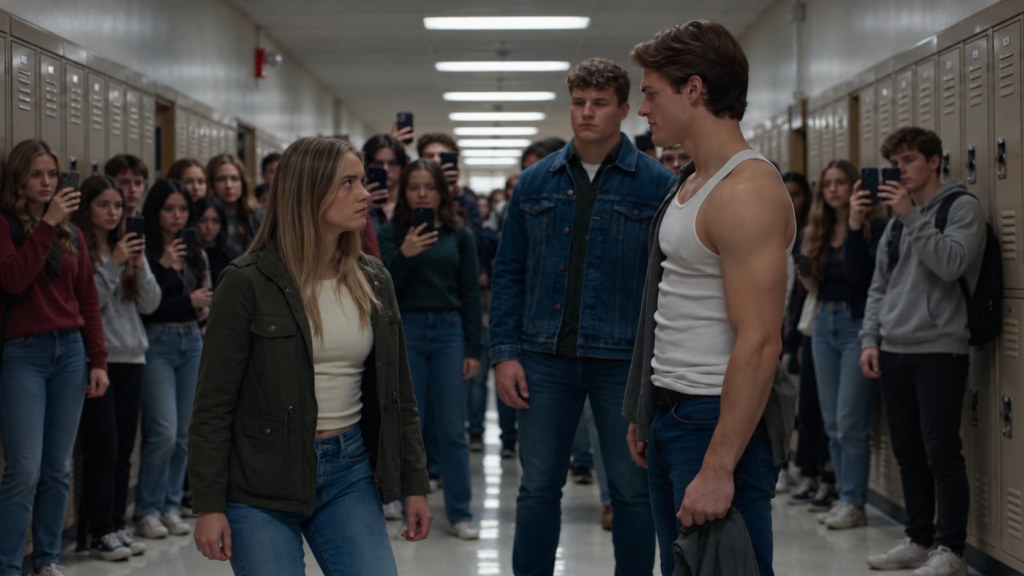
The east corridor was crowded between classes.
Beckett stood near the trophy cabinets with Tucker and Mason.
Vera saw them, saw the phones rising, and stopped.
Behind her, more students pressed through the double doors.
“Scholarship Girl,” Tucker called. “We saved you a front row.”
She turned toward the stairwell.
Beckett caught the back of her jacket.
“Don’t be rude. My mother bought your ticket here.”
“Let go,” Vera said clearly.
Leila, emerging from a classroom, heard the words before seeing her.
Beckett pulled harder. A sleeve seam split with a sharp crack.
The jacket slipped from Vera’s shoulder into his hand.
Tucker grabbed the strap of her bag, dragging her sideways.
Her dress caught on the bag buckle and tore along an outer seam.
A plain undershirt and leggings kept her covered beneath the damaged fabric.
Someone laughed. Someone else said, “Stop.” Nobody moved quickly enough.
Vera felt panic rise, then recognized the cold edge beneath it.
She set down her lunch container with deliberate care.
“Give me room,” she said.
Beckett held the jacket higher. “What are you hiding?”
“My father was a Marine. He taught me to get home.”
“So you’re going to karate chop us?”
“I’m giving you one chance to walk away.”
He reached for her again.
What happened next was brief, awkward, and nothing like a movie.
Vera broke free as Beckett lost his balance against Tucker.
Mason stepped forward into the collision and fell against the lockers.
Tucker went down trying to catch himself on a moving backpack.
Vera created space, retreated, and lifted both empty hands.
She did not follow anyone to the floor.
Beckett stayed conscious, shouting through a split lip.
Tucker clutched his wrist. Mason sat stunned beside the cabinets.
“Call campus security,” Vera said, her voice suddenly shaking.
Leila reached her and wrapped the torn jacket around her shoulders.
A hundred versions of the incident were already leaving the hallway.
The first had no sound. The second began after Beckett grabbed her.
The third carried a caption claiming she had attacked without warning.
Security arrived to find three athletes down and one girl standing.
An officer took Vera’s bag before asking for her name.
In the silence that followed, Beckett finally found his audience again.
“She went crazy,” he said. “Everybody saw it.”
The interview room smelled of old coffee and disinfectant.
Vera sat under an air vent wearing a borrowed campus sweatshirt.
Officer Alvarez placed a paper cup of water within reach.
“Are you injured?” she asked.
“My shoulder. I don’t know about anything else.”
“Medical assessment first, then questions.”
Outside the door, another officer described the event as a fight.
Vera watched Alvarez write down a different phrase: reported physical assault.
It was the first sign that somebody had heard her.
Eleanor arrived with her cardigan buttoned wrong and her keys still clenched.
She knelt beside the chair before remembering there were people watching.
“You’re here,” Vera said, surprised by how young she sounded.
“Yes. I’m here.”
At the clinic, a nurse documented bruising and cleaned her scraped palm.
Vera consented to photographs, staring at a poster about seasonal allergies.
She asked the nurse to save the damaged clothing separately.
She had remembered that from a procedural television show, not her father.
The distinction mattered somehow. She was allowed to know things herself.
By evening, the university had issued an interim suspension from classes.
The email used neutral words that landed like a verdict.
Pending review. Campus access restricted. Contact only through designated staff.
Beckett’s name did not appear in the message.
Eleanor read the attachment while Vera sat on the kitchen floor.
The old position. The old boxes. A different kind of helplessness.
“We’ll ask what process applies,” Eleanor said.
“I have a scholarship review next month.”
“We’ll ask about that too.”
“I did what he taught me.”
Her mother set the laptop aside.
“Getting away was right. Being scared afterward doesn’t change that.”
Leila called with the first piece of good news.
She had saved twelve videos before several accounts deleted them.
One began twenty seconds before the jacket tore.
“You say let go twice. It’s clear.”
Vera closed her eyes and finally drank the water beside her.
Then Leila added that the official student newspaper had declined the story.
Its adviser wanted to wait for the administration’s approved statement.
“I write for the independent one,” she said. “We have other standards.”
“Don’t put my clinic photographs online.”
“I won’t publish anything private without asking.”
That promise let Vera breathe more easily than the video had.
Near midnight, another message arrived from an unknown number.
Take responsibility and nobody needs to lose their future.
Eleanor photographed it using her own phone.
Then she turned Vera’s device face down.
“You don’t have to stand watch all night.”
Vera looked toward the photograph on her desk through the bedroom doorway.
For once, she did not promise Danny she would be strong.
She whispered that she was tired.
Somehow that felt closer to telling him the truth.
The next morning, Eleanor called a student advocacy clinic downtown.
By noon, they were sitting across from attorney Naomi Chen.
Naomi read the suspension notice before watching a single video.
“First, we separate what happened from what people are calling it.”
Vera studied a chipped corner of the desk.
“What if the committee believes him?”
“Then we use the review process. But let’s build the record.”
Naomi asked for messages, dates, medical documentation, and the original files.
She explained that cropped clips could hide timing and missing context.
She also explained that an attorney could not promise a particular outcome.
Vera trusted that more than she would have trusted certainty.
They requested preservation of corridor footage and relevant university records.
Naomi sent questions about restrictions, accommodations, and the scholarship’s actual conditions.
Then she asked Vera to describe the encounter in her own words.
Not the version she thought would sound brave or convincing.
Vera began with the false classroom message.
Halfway through, her hands started trembling beneath the desk.
Naomi offered a break without making it sound like a test.
In the waiting room, Eleanor bought crackers from a vending machine.
Vera ate three and realized she had barely eaten since Monday.
Her phone showed an email from Dr. Mercer.
I can arrange remote access to this week’s material while restrictions are reviewed.
Below it was a second sentence.
Your place in my classroom is an academic matter, not a popularity contest.
Vera read that sentence twice.
Meanwhile, Leila worked from a corner table at the public library.
Owen helped organize submissions from students who had witnessed the incident.
They kept names separate from files and asked permission before sharing anything.
One student had filmed Beckett catching Vera’s jacket from behind.
Another had recorded Tucker pulling her bag.
A third had lowered his phone and could only describe the crowd.
Leila thanked him anyway. Human memory was evidence worth handling carefully.
By afternoon, the independent paper’s editor, Rosa Kim, joined them.
She rejected Leila’s first headline within five seconds.
“Viral isn’t the same as verified. Start with what we know.”
They wrote a timeline instead of a verdict.
At three, Beckett posted a photograph of his bruised face.
He described a terrifying attack and thanked supporters for their prayers.
He did not mention the jacket, the bag, or the false message.
Vera opened the comments, then closed them when her chest tightened.
Owen texted a photograph of her unfinished engineering diagram.
We can work through problem six when you feel up to it.
She almost replied that nothing was ordinary enough for homework now.
Instead, she asked him to explain the second equation.
For twenty minutes, force meant something that could be calculated.
Then Naomi called with an update from the university.
The review office would consider temporary access to remote classes.
It was a small concession, and Vera understood its limits.
Still, she took her textbook out of her bag.
Somebody else had tried to decide her future; she had work to do.
Mason Price watched the hallway video in his parked car.
Not the popular version, which made the collision look like an ambush.
The original on his phone, beginning well before Vera arrived.
His own voice was in it, laughing when Beckett tested the seam.
He stopped the recording before he heard the fabric tear.
Then he started it again, because stopping changed nothing.
His father called three times before Mason answered.
“Celia says attorneys are handling this. Don’t freelance.”
Mason watched students moving past the windshield with coffee and backpacks.
“She told him to let go,” he said.
“I’m talking about protecting your future.”
“So am I.”
But he ended the call without doing anything useful.
Across town, Leila interviewed a student named Ana Torres.
Ana had withdrawn from Westbrook during the previous spring semester.
Her transfer credits were still tangled in an unresolved administrative appeal.
At first, she wanted to speak only about campus culture.
Then Leila mentioned Tucker’s name, and Ana went very still.
“He posted a video of me crying at a party.”
“Did you report it?”
“Yes. They suggested mediation. I wanted the video taken down.”
Leila asked what documentation Ana was comfortable providing.
Ana sent emails showing appointments postponed until after she left.
They did not prove everything she remembered.
They did prove that someone had been asking for help.
Leila told Rosa they might have a second story.
Rosa shook her head. “We have a lead. Keep reporting.”
That evening, Vera received a message from Mason’s real account.
I need to tell you something. Alone.
She forwarded it to Naomi before answering.
No private meetings. Send anything relevant through my adviser.
For several minutes, the typing indicator appeared and vanished.
Then Mason sent a single sentence.
The room change wasn’t from the department.
Vera stared at the words while Eleanor stood beside her.
“Do we ask him who sent it?”
Naomi’s reply arrived before they decided.
Keep the message. Don’t pressure him. I’ll offer a formal channel.
On campus, Beckett waited for Mason outside the athletic building.
“People are saying you’re upset,” he said.
“Three people got hurt. Should I be celebrating?”
Beckett’s smile sharpened. “Don’t make yourself the fourth.”
Mason looked toward the security camera above the doorway.
For the first time all week, he wished it had sound.
He went to the library instead of the locker room.
Owen saw him standing beside the returns desk and stopped working.
“If you’re looking for Vera, she isn’t here.”
“I know.” Mason swallowed. “Is Leila?”
Owen did not move until Mason put his phone on the counter.
“I have the beginning,” he said. “All of it.”
Leila refused to watch the file until Rosa arrived.
Mason sat across from them, his knee bouncing under the table.
“I wasn’t planning to hit her,” he said.
Rosa opened her notebook. “Tell us what you were planning.”
There was no answer he could make sound innocent.
A prank. A clip. Something to put the new girl in place.
He had agreed to film because Beckett had asked.
He had seen Tucker borrow a profile picture from the department website.
He had laughed when the fake room change went into the group.
Each admission made the room feel smaller.
“Did Beckett tell you to delete the recording?” Leila asked.
Mason nodded and opened their group conversation.
Delete your angles. Let the official camera handle it.
Below that, Tucker had written that the official camera was useless anyway.
Mason explained that the lens near the trophy case faced the entrance.
Its view of the side corridor was partly blocked by a display.
They had joked about the blind spot before Vera arrived.
Leila felt a coldness that had nothing to do with the library.
“Did you know her clothes would tear?”
“I knew he was going to grab the jacket.”
“That’s not the question.”
Mason looked down. “I didn’t ask what else might happen.”
Rosa asked permission to copy the original recording and relevant messages.
She explained that they would seek responses from everyone named.
Mason agreed, then asked whether his name could disappear from the article.
“We can discuss protecting a source,” Rosa said. “We can’t rewrite events.”
When Vera saw the recording with Naomi, she expected relief.
Instead, hearing their laughter made her feel sick.
There was a moment before she entered the corridor when Beckett rehearsed.
He pointed at the doorway and told Tucker where to stand.
Vera paused the screen with her own image still out of frame.
“They were waiting for me.”
Naomi let the silence settle before answering.
“Yes. This supports that.”
For weeks, Vera had wondered what she could have done differently.
Taken another path. Chosen different clothes. Smiled at the original joke.
Now she saw how many decisions other people had made first.
The realization did not heal anything immediately.
It did loosen one knot she had mistaken for responsibility.
Eleanor reached for her hand under the table.
That night, Mason sent Naomi a copy of the recording himself.
He included a statement that began without excuses.
I helped arrange the encounter and recorded it.
Then he called his father and told him what he had done.
His father listened in a silence Mason had never heard before.
“You understand what this could cost?”
Mason looked at the screen showing Vera surrounded by raised phones.
For the first time, he thought about what silence had already cost her.
“Yes,” he said.
He stayed on the line and let his father be angry.
Celia Callaway asked Eleanor to meet at a hotel café.
The invitation described a conversation between mothers, away from unnecessary conflict.
Eleanor forwarded it to Naomi, then declined the private meeting.
A second invitation arrived through the foundation’s lawyer the next day.
This one included a proposed resolution.
Vera would acknowledge that emotions had escalated on both sides.
The foundation would guarantee her scholarship through graduation.
The agreement also required silence about the encounter and its resolution.
Eleanor read the tuition figure and felt ashamed of noticing it first.
Four semesters of certainty. Rent that might become manageable. One less terror.
Then she imagined Vera carrying a lie through every classroom.
She asked for a call with Naomi and her daughter.
Naomi explained the terms without telling them what they ought to want.
Vera stared at the guarantee of funding.
“They can promise this now?”
“The foundation can offer money,” Naomi said. “Read what it asks back.”
Vera read the silence clause again.
She thought of Ana, whose name Leila had mentioned with permission.
She thought of younger students arriving next fall with new notebooks.
“I won’t say we both arranged what happened.”
Eleanor nodded, though her stomach still tightened around the numbers.
Naomi sent a refusal and preserved the proposal privately.
It was not a public exhibit, and they did not treat it as one.
The next morning, Eleanor attended an interview at a small repair company.
She wore the shoes she had polished while waiting for clinic results.
The owner, Marianne Bell, noticed the gap in her recent employment.
“My husband died,” Eleanor said. “We moved here afterward.”
Marianne expressed condolences, then asked about payroll software.
For forty minutes, Eleanor answered questions nobody had designed to humiliate her.
She left with a part-time offer and cried in the parked car.
Not because everything was solved.
Because something had finally happened that belonged to her.
At home, Vera had spread her engineering drawings across the kitchen table.
Dr. Mercer had arranged a video appointment for five o’clock.
“I was thinking of withdrawing,” Vera admitted before the call began.
Eleanor sat down opposite her.
“Because you want another school, or because they want you gone?”
Vera touched the corner of a drawing her father had annotated.
“I don’t know yet.”
“Then you don’t have to decide today.”
At five, Dr. Mercer appeared on the laptop wearing safety goggles.
She pushed them onto her forehead and apologized for losing track of time.
“Show me the joint that’s giving you trouble.”
Vera turned the camera toward a sketch instead of her face.
Within minutes, she was arguing about a design rather than defending her character.
When the call ended, she found she was hungry.
Eleanor cooked eggs. Vera made toast. One piece burned beyond recovery.
They laughed before either could decide whether laughter was appropriate.
Later, Vera completed the refusal letter by adding one sentence.
I want to remain a student without being required to deny what happened.
Rosa published the first article on a rainy Thursday morning.
It opened with the timeline and linked only to carefully reviewed footage.
The torn clothing appeared nowhere in the thumbnail.
Vera had asked for that, and the editors had listened.
The article quoted her warning and Mason’s admission about the staged encounter.
It included the university’s statement that the review remained ongoing.
Beckett’s lawyer denied that his client had intended any injury.
Tucker did not respond by the stated deadline.
Within an hour, students began sharing the full opening of Mason’s recording.
The popular headline elsewhere became Three Bullies Knocked Out by Marine’s Daughter.
It was false in several directions, but faster than the truth.
Strangers called Vera a warrior, a weapon, a future action star.
Someone made a slowed-down montage and added sound effects.
She asked Leila to help request its removal.
“I don’t want to keep living inside four seconds,” she said.
Leila quoted that only after Vera approved it.
The sentence traveled more slowly, but it reached different people.
A graduate student wrote about being afraid to report harassment.
A lecturer offered notes from a class Vera was missing.
Two students admitted they had watched and done nothing.
One apologized without asking her to make him feel better.
She appreciated that one most.
By afternoon, the athletics director placed Beckett and Tucker on temporary leave.
Mason was also restricted from team activities while the inquiry continued.
None of the notices announced a final finding.
Vera understood the distinction even when online commenters ignored it.
That evening, a national producer requested an interview and training demonstration.
The proposed segment would introduce her as the girl nobody should mess with.
She declined before discussing the payment.
Owen arrived with groceries and a problem set printed in large type.
“Your printer hates the margins,” he explained.
“My printer hates having a job.”
They worked while Eleanor completed payroll training at the other end of the table.
For almost an hour, the apartment sounded like a working household.
Then somebody knocked hard enough to stop all three of them.
Owen stayed seated while Eleanor checked the peephole.
A delivery driver held a bouquet larger than the kitchen sink.
The card said apologies should be as public as accusations.
There was no signature, but the florist receipt listed Beckett’s account.
Vera photographed it, then asked that the flowers go downstairs.
They arranged through Naomi that all further contact use the designated channel.
At midnight, the university approved Vera’s return to remote coursework immediately.
It also scheduled a review of the physical campus restrictions.
The message was bureaucratic, imperfect, and more useful than a thousand roses.
Vera forwarded it to Dr. Mercer.
Then she set an alarm for her morning lecture.
Across town, Beckett watched his follower count rise with every hostile repost.
He mistook attention for control, as he always had.
This time, however, the original recording remained available beneath his denial.
For the first time, he could not choose where the story began.
Vera returned to campus nine days after the hallway incident.
The morning smelled of wet leaves and coffee from the student kiosk.
She had imagined applause, hostility, or a silence that meant both.
Instead, a cyclist nearly hit a rubbish bin while checking his phone.
The ordinariness almost made her laugh.
Leila met her beside the back entrance, as they had agreed.
No filming. No announcement. Just a friend holding an extra coffee.
The review office had issued instructions limiting contact between the students involved.
Vera carried a copy, though she hated needing it.
At the engineering building, her feet stopped beneath the fluorescent lights.
Not the same corridor. Not the same doors.
Her body noticed neither distinction.
Leila waited beside her without touching her unexpectedly.
“We can use the courtyard entrance.”
“I know.”
Vera watched a maintenance worker replace a ceiling panel overhead.
The ladder was blue. His radio played a weather report.
She named those things silently until the room became a room again.
Then she chose the courtyard entrance.
In the lab, Dr. Mercer pointed to an empty workstation.
“Your team has questions about the linkage model.”
Three classmates looked up, trying too hard to look casual.
One introduced herself again despite having done so weeks earlier.
Vera was grateful for the chance to start badly and normally.
Her project involved a simple lifting aid for home caregivers.
Danny’s first drawing had been for an injured neighbor in Ohio.
Now Vera wanted the mechanism to require less grip strength.
A teammate named Priya suggested replacing the rigid handle with a broader loop.
Vera disagreed, then listened, then altered the drawing.
It was the first argument she had enjoyed all month.
At lunch, a stranger asked for a selfie and raised his phone.
“No, thank you,” Vera said.
He persisted until Owen stepped beside the table.
“She answered you.”
The student muttered something and left.
Owen sat only after Vera moved her bag from the chair.
“Did you need me to do that?” he asked.
“Maybe. But ask before turning into my bodyguard permanently.”
“Fair.”
He opened his sandwich, and she liked him for accepting the correction.
That afternoon, the scholarship office requested an updated eligibility review.
The email arrived three weeks earlier than the published schedule.
Vera’s stomach dropped before she finished the subject line.
Naomi asked for the reason and the applicable written policy.
Dr. Mercer supplied a statement confirming Vera’s academic standing.
Eleanor sent no angry emails, although she drafted four.
By evening, the office clarified that funding would continue during the review.
It did not explain why the review had moved.
Vera placed the message in the same folder as everything else.
Then she returned to the drawing with Priya’s better handle.
The hardest day arrived without a message from Beckett.
It was her father’s birthday.
Eleanor had written it on the kitchen calendar months before they moved.
The number sat inside a small blue circle, unbearably ordinary.
Vera skipped breakfast and told herself she had an early lecture.
At campus, she walked past the engineering building and kept going.
She stopped at a municipal park beyond the south parking lots.
A father was teaching a little girl to ride a bicycle.
Every time he let go, she shouted at him to hold on.
Vera sat on a bench until the scene became impossible to watch.
Her phone rang with Eleanor’s name.
For a moment, she considered letting it ring.
Then she answered because losing one parent had made missed calls frightening.
“Where are you?”
“The park.”
“Would you like company?”
Vera pressed her thumb against the corner of her phone.
“Yes.”
Eleanor arrived carrying two supermarket cupcakes in a transparent box.
Neither one had thought to bring candles.
“Your dad would have called that efficient,” Eleanor said.
“He hated birthday speeches.”
“He loved giving them to everyone else.”
They ate with plastic spoons and watched ducks investigate an empty bag.
After a while, Vera admitted something she had never said aloud.
“I wasn’t talking to him the morning he died.”
Eleanor turned toward her slowly.
“We argued about college. I wanted to go farther away.”
Her mother remembered the argument. Of course she did.
Vera had slammed a cupboard. Danny had asked her to stop.
Then he had left to help a friend move furniture.
“I keep thinking my last words should have been different.”
Eleanor set her spoon on the empty box.
“Your last words weren’t the whole conversation you had with him.”
Vera looked down at icing smeared across her thumb.
“He knew you wanted your own life. He wanted that too.”
A bicycle bell rang somewhere behind them.
Vera cried without keeping her face still, without arranging the grief attractively.
Eleanor stayed until the crying became breathing again.
That evening, they unpacked the last box of Danny’s belongings.
There were socks, a cracked watch, and an absurd collection of spare screws.
No secret inheritance. No letter predicting the woman Vera would become.
Just evidence of a man who expected to come home.
Vera put the watch beside his photograph.
Then she emailed the campus counseling service for an appointment.
She had been treating help like something she must earn by failing harder.
Now she wanted to try another way.
Before bed, she took the black belt out of its box.
She placed it in a drawer where she could find it easily.
It did not have to stand guard anymore.
Three days before the disciplinary hearing, Mason changed his statement.
The revised document described confusion and denied knowledge of a planned confrontation.
Naomi called Vera before she could discover it in the case materials.
“The original recording remains. So do the messages he already provided.”
Vera stared at the hearing schedule on her screen.
“He can just change what he said?”
“He can make another statement. The panel can consider the differences.”
It sounded both reasonable and wildly insufficient.
That afternoon, Leila received a request to remove Mason’s name from her article.
His father claimed the young man had spoken under emotional pressure.
Rosa preserved the correspondence and offered to report his response accurately.
She did not erase a documented interview because someone regretted giving it.
Mason stopped answering calls from everyone except his parents.
His father had threatened to stop paying tuition if he testified.
Beckett had promised their friendship would survive if he corrected his mistake.
In Mason’s bedroom, both versions of himself seemed equally frightened.
One feared losing comfort. The other feared recognizing why he kept it.
Meanwhile, Tucker’s adviser submitted a challenge to the video evidence.
A copied clip had an apparent gap near the collision.
Leila panicked until Owen compared it with the original file.
The gap came from the copy, which had frozen during a download.
The original recording ran continuously through the relevant sequence.
Rosa provided the source file and explained the difference in writing.
Naomi told Vera the challenge would be addressed at the hearing.
Vera wanted certainty she could carry around like a shield.
Instead, she got careful preparation and a folder that kept growing.
They practiced answering questions without guessing what another person had intended.
“What happened when he reached toward you?”
“I believed he was grabbing me again.”
“Did you mean to knock all three down?”
“I meant to get out. I can’t explain every movement afterward.”
Naomi nodded. “Then don’t pretend you can.”
On the final practice run, Vera forgot the sequence and started crying.
She expected disappointment. Naomi offered her a tissue.
“A hearing isn’t an acting audition. You can ask for time.”
That evening, Owen brought the prototype’s new handle to the apartment.
Priya had printed it in bright orange because the black filament ran out.
“It looks like rescue equipment,” Vera said.
“It looks like our printer has a budget.”
They tested the grip using a bag of rice from Eleanor’s cupboard.
The loop flexed, held, and left no sharp pressure against Vera’s palm.
Something worked. She badly needed something to work.
After Owen left, an email from Mason reached Naomi.
It contained no revised narrative, only a question.
If I tell the truth at the hearing, can my parents stop me?
Naomi answered within the limits of her role and suggested independent advice.
She did not promise to protect him from consequences at home.
Mason read the reply sitting beside his packed athletic bag.
Then he deleted Beckett’s latest message without answering.
For once, deletion was the beginning of a better decision.
The hearing took place in a conference room overlooking the athletics field.
Vera wished somebody had thought harder about the windows.
A staff member offered an alternative seat without making her explain.
She chose the one facing a blank wall.
The panel chair introduced the members and described the procedure.
Everyone would have time to speak, respond, and request a break.
The university’s decision would address its conduct rules, not replace a court.
Vera listened carefully. She wanted the limits stated as clearly as the powers.
Beckett sat at a separate table with his adviser.
He wore a suit that made him look like an imitation of his father.
When their eyes met, he looked away first.
Vera felt no triumph. She wanted the morning to end.
The investigator summarized the reports, records, messages, and conflicting statements.
Then the full hallway recording played on the conference room screen.
Without music or captions, the laughter sounded smaller and uglier.
Vera heard herself ask for space.
She watched Beckett reach again after her warning.
When the collision came, she looked at the water glass instead.
The panel chair paused before asking whether she needed a break.
“Two minutes,” Vera said.
She had practiced those words more than her opening statement.
When they resumed, Beckett described a joke that got out of hand.
He said he had expected her to laugh.
A panel member asked why he had continued after she told him to stop.
For several seconds, his adviser was the only person writing.
“I didn’t realize she was serious.”
The panel replayed the request without the surrounding noise.
It sounded serious to everyone in the room.
Tucker said he had grabbed the bag to stop it falling.
Another recording showed him taking the strap before Vera lost her balance.
He said the angle was misleading.
The investigator showed a second angle.
Nobody raised a voice. Nobody needed a dramatic speech.
The questions became more exact as the answers became less useful.
Then Vera was asked about her training.
She explained that her father had taught her self-defense over several years.
She did not claim a rank she had never formally earned.
“Your father was a Marine?” one member asked.
“Yes. That’s part of my life. It doesn’t explain what they chose.”
Naomi sat still beside her, allowing the answer to stand.
A question followed about why she had not left sooner.
“The stairwell was behind him. Students were crowding the other direction.”
She described the hallway without pretending every exit had vanished.
There had been paths. There had also been people blocking them.
“I tried to leave before he grabbed me,” she finished.
The chair consulted the timeline and made a note.
Outside the room, a door opened and closed.
A staff member approached the panel with a message.
Mason Price had arrived and wished to correct his latest statement.
Vera placed both feet on the floor and waited.
Mason entered without his father or his team’s adviser.
A student support representative sat beside him after the chair explained his options.
He looked at the table when asked which statement was accurate.
“The first one. I changed it because I was afraid.”
“Afraid of whom?”
“My father cutting me off. Beckett deciding I’d betrayed him.”
The panel asked whether anyone had dictated his original account.
“No. I gave the recording because I knew what happened.”
He explained the fake classroom notice and the plan to film Vera.
He admitted standing where Beckett had asked him to stand.
“I wanted to believe holding the phone made me less involved.”
For the first time, he looked toward Vera.
“It didn’t.”
The chair redirected him to the panel rather than permitting a private exchange.
Vera was grateful. She could not manage his regret as well as her fear.
After questions, the panel allowed each respondent to address the additional testimony.
Beckett called Mason unreliable and said their messages were jokes.
Then a panel member read the instruction about deleting recordings.
“What was the joke in this sentence?” she asked.
Beckett looked at his adviser before answering that he could not remember.
Vera’s final statement was shorter than the one she had rehearsed.
“I came here to study engineering. I would like to do that.”
She folded her notes before she began repeating herself.
The hearing ended without an immediate decision.
Outside, afternoon practice had begun on the field.
Whistles drifted across the lawn as though nothing significant had happened.
Eleanor met her daughter beside the steps and asked about lunch.
Vera almost laughed at the size of the question.
Then she realized she was hungry enough to answer it.
They ate noodles in a restaurant with faded menus and excellent soup.
For forty minutes, nobody asked her to describe the hallway.
The decision arrived four days later, at six seventeen in the evening.
Vera opened it with Eleanor and Naomi on a video call.
The panel found Beckett responsible for targeted harassment and physical misconduct.
It found Tucker responsible for his role in the planned encounter.
Mason was found responsible for participation and related conduct.
The sanctions differed because their actions and cooperation differed.
Beckett was expelled. Tucker received a substantial suspension with conditions for return.
Mason received a suspension, probation, and restrictions on extracurricular participation.
Vera was not found responsible for the alleged assault under university rules.
The panel concluded that her actions were directed toward escaping the encounter.
The notice described the available appeal process for all parties.
Vera read her own finding three times.
She had imagined screaming when this moment came.
Instead, she asked whether the kettle was already boiling.
Eleanor said yes and started crying quietly into her hands.
Naomi stayed on the call until they had read the practical next steps.
Then Vera put down the laptop and held her mother.
Winning, she discovered, could feel very much like finally being allowed to rest.
For that evening, rest was enough.
The campus did not transform overnight because a panel issued findings.
Students still whispered when Vera entered the dining hall.
A professor congratulated her in front of a class without asking first.
She thanked him afterward, then explained why it had embarrassed her.
He apologized and did better the following week.
That mattered more than another speech about courage.
Beckett appealed, and the university notified Vera through the formal process.
Naomi helped her respond without rewriting the entire account again.
The appeal was denied after review of the stated grounds.
Vera printed the final notice, then put it away.
Her scholarship remained a separate uncertainty.
The foundation had postponed its early review without canceling it.
Celia continued to chair the board that controlled the award.
Naomi requested an independent assessment because of the obvious conflict.
At first, the foundation said its existing safeguards were sufficient.
Then Rosa’s second article raised questions broader than Vera’s individual award.
Ana had agreed to share selected emails from her unresolved complaint.
Other former students supplied records of delays, unanswered questions, and inconsistent guidance.
The paper distinguished their allegations from findings nobody had made.
Even so, the pattern was difficult to dismiss as one misunderstanding.
Faculty representatives asked the university to commission an external process review.
Several alumni demanded that scholarship decisions be separated from disciplinary influence.
One anonymous donor offered Vera money if she agreed to leave Westbrook.
She declined through Naomi without turning the offer into another spectacle.
She did not want escape sold back to her as generosity.
Eleanor had begun working four mornings a week at Marianne’s company.
She could not replace the scholarship, but she could plan beyond Friday.
That small change altered how they talked about the future.
They stopped beginning every sentence with if we can afford it.
They still thought it. They simply made room for other words.
In December, the university announced an independent scholarship review arrangement.
The new committee assessed grades, attendance accommodations, and financial eligibility.
Vera supplied what it requested and waited through an ordinary weekend.
On Monday, the confirmation arrived before her first lecture.
Her award would continue under its original academic terms.
No acknowledgment of shared blame. No promise of silence. No special performance.
She showed Eleanor the email over breakfast.
Her mother read it while holding the toast above her plate.
Then she lowered the toast and took a long, steady breath.
Across campus, Celia stepped down from the foundation chairmanship.
Her statement referred to family priorities and the need for institutional confidence.
Vera did not try to decide how much of it she believed.
She had spent enough hours interpreting other people’s intentions.
That afternoon, she bought a notebook without calculating how many pages remained.
On the first page, she wrote measurements for the lifting aid.
On the second, she listed questions for the neighborhood rehabilitation center.
Dr. Mercer had arranged a supervised consultation about actual caregiver needs.
Vera looked at the two pages before closing the cover.
For the first time since arriving, her plans extended beyond surviving the semester.
She carried them into the lab herself.
The university invited Vera to speak at a campus safety forum.
The first email called her an inspiring symbol of student resilience.
She left it unanswered for two days.
The second came from the student organizers instead of the communications office.
They asked what would make participating useful rather than exhausting.
That question persuaded her to consider it.
She agreed to speak for five minutes under specific conditions.
No hallway footage. No demonstration. No questions about how she had trained.
A counselor would attend, and other students would have equal speaking time.
The organizers agreed without negotiating her boundaries into something more convenient.
Before the forum, Vera visited Ana at a café near the bus station.
Ana was studying at another college now and working evenings.
She did not want an invitation to become a cautionary tale.
She wanted her unresolved records corrected so her transfer could proceed.
Vera listened, recognizing the practical exhaustion beneath the larger injustice.
“Can I mention the delays without using your name?”
“Yes. But say the delay was part of the harm.”
Vera wrote that down exactly.
At the forum, the auditorium was only half full.
She found that reassuring. An audience did not have to be enormous to matter.
Leila sat near the aisle with her notebook closed.
Eleanor sat beside her, wearing the cardigan with the stubborn red stain.
It had faded but never disappeared completely.
Vera stepped to the microphone holding one sheet of paper.
“I don’t think students should need self-defense training to attend class.”
The room became still in a way that did not frighten her.
She described reporting problems before the hallway incident.
She explained what clear responses, timely appointments, and understandable instructions could change.
She said bystanders needed options besides filming or rushing into danger.
Calling for help mattered. Making space mattered. Preserving evidence mattered.
So did asking the person affected what they wanted afterward.
Then she put down the page.
“The worst part wasn’t discovering that someone wanted to hurt me.”
She paused until the words felt like hers again.
“It was wondering whether I had to lose my education to say so.”
Nobody applauded immediately, which she appreciated.
A student in the third row raised his hand during questions.
“I was in the hallway. I didn’t do anything useful.”
Vera waited.
“What should I say to you now?”
She considered several answers before choosing the simplest.
“Tell the truth if someone asks. Do something useful next time.”
He nodded and sat down without asking for forgiveness.
Afterward, the organizers collected written proposals rather than posing for a photograph.
The university committed to publishing progress reports with dates and responsible offices.
Vera knew a promise was not the same as a change.
Still, a dated promise could be checked.
Outside, Eleanor slipped her arm through her daughter’s.
“You sounded like yourself,” she said.
It was the compliment Vera had wanted without knowing its name.
Mason requested a meeting in January, after his suspension period ended.
The request came through the conduct office, with no expectation that Vera agree.
She left it for a week before discussing it with her counselor.
“What would you want from the meeting?” the counselor asked.
“I’m not sure. Maybe to stop rehearsing it in my head.”
“And what would make you leave?”
“An excuse dressed up as an apology.”
They wrote that down, and Vera decided to attend with a facilitator.
Mason arrived early and sat with both hands visible on the table.
He looked thinner, but Vera refused to treat that as evidence of change.
“I helped make you a target,” he began.
“I filmed because I thought Beckett’s approval made me somebody.”
He stopped himself before explaining how difficult his father had been.
“That isn’t your responsibility. None of it is.”
The facilitator asked him to describe the harm he understood.
He mentioned the damaged clothes, the bruises, and the missed classes.
Vera waited until he finished.
“You made strangers think they owned a piece of what happened to me.”
Mason looked down, then back at her.
“I hadn’t understood that part.”
“Then understand it now. Don’t use my story to advertise your improvement.”
He nodded without asking whether she forgave him.
The meeting ended after twenty minutes.
Outside, she felt neither healed nor cheated.
She had said what she wanted, and nobody had made her stay longer.
That was enough to justify the afternoon.
Beckett never requested such a meeting.
Through his lawyer, he continued to dispute portions of the university’s account.
Vera’s separate complaint proceeded through the local justice system over subsequent months.
Naomi explained each development privately; Vera stopped giving the internet updates.
Eventually, a negotiated resolution included accountability, restitution, and restrictions on contact.
It did not arrive with the public confession strangers had demanded for her.
Tucker’s process reached its own conclusion on a different schedule.
Vera learned that real consequences rarely formed one satisfying final scene.
She could accept an ending without pretending it repaired the beginning.
With the compensation for damaged property, she replaced her bag and Eleanor’s cardigan.
Her mother kept the old cardigan for gardening anyway.
They did not yet have a garden, which made the decision optimistic.
One Saturday, Owen invited Vera to a cheap film at the student cinema.
“Is this a date?” she asked.
“I hoped it could be. It’s also okay if it isn’t.”
She appreciated the courage of a question that allowed an unwelcome answer.
“Yes,” she said. “But I’m choosing the snacks.”
The film was terrible in a way that gave them plenty to discuss.
Halfway home, she reached for his hand because she wanted to.
He did not turn the moment into a promise he could not make.
At her building, he asked whether she wanted company upstairs.
“Tomorrow,” Vera said. “Tonight, I want to sleep.”
He kissed her cheek and waited until she was inside.
She slept with her phone charging across the room.
The prototype failed three days before the spring engineering exhibition.
Not dramatically. A joint slipped under load, and the mechanism sagged sideways.
Priya stopped the test while Vera stared at the orange handle.
Owen, visiting with lunch, wisely said nothing about the timing.
They lowered the weighted dummy and checked the frame for damage.
Dr. Mercer read their notes before offering an opinion.
“Better here than in someone’s living room. What changed between tests?”
Vera wanted to say everything, which was accurate and useless.
Instead, she listed materials, fasteners, assembly order, and load position.
Priya noticed a tolerance difference in the replacement hinge.
They measured it twice, found the mismatch, and revised the connection.
It took six hours and one disagreement over whose calculations were outdated.
The calculations were Vera’s. She corrected them and bought dinner.
At midnight, she opened the old drawing with Danny’s annotations.
She had been preserving his dimensions long after their design had changed.
The realization hurt more than discovering her own arithmetic error.
For a moment, changing the frame felt like arguing with a dead man.
Then she remembered how often Danny had thrown away his first attempt.
He would have hated being turned into a rule against improvement.
Vera crossed out the old dimension and wrote the new one.
Beside it, she added his initials to the original concept credit.
There was room on the page for both things.
On exhibition morning, Eleanor arrived in a blue blouse bought with her wages.
Leila brought a camera and asked before taking a single photograph.
Ana came with confirmation that her transfer records had finally been corrected.
She showed Vera the email as though it were an admission ticket.
“It shouldn’t have taken this long,” Vera said.
“No. But I’m celebrating anyway.”
Their display explained the project’s limits as carefully as its possibilities.
The device was a student prototype requiring further testing and professional review.
It was not ready for people to use at home.
Several visitors seemed disappointed by the lack of miraculous claims.
A caregiver from the rehabilitation center looked relieved.
“Good,” she said. “Now show me what it actually does.”
Priya demonstrated the mechanism with the weighted dummy.
The hinge held. The handle distributed pressure. The frame stayed steady.
Vera answered questions without thinking about what her hands looked like.
When someone recognized her from the hallway clip, he hesitated.
“Sorry. I came over for the project.”
“Then ask about the project,” she said, smiling.
He did, and she talked for ten uninterrupted minutes.
Their team won a modest development grant and access to summer lab space.
There was no giant cheque, only an email and more paperwork.
Vera wanted the paperwork immediately.
After the exhibition, she found Eleanor beside the display credits.
Her mother was looking at Danny’s name beneath the original concept.
“He’d have asked whether the hinge was rated properly,” Eleanor said.
“And then told every cashier in town we’d won.”
They laughed, and this time the laughter did not break.
Behind them, Priya began planning a better version.
A year after moving to Westbrook, Vera finally emptied the last cardboard box.
It contained a curtain rod, two mugs, and a map of Ohio.
She had forgotten all three and recognized them instantly.
Eleanor held the map open across the kitchen table.
“Keep it?” she asked.
“Yes. We can have more than one place we came from.”
They folded it along the old creases and put it in a drawer.
The apartment now contained plants they occasionally remembered to water.
There were bills on the counter, but fewer envelopes left unopened.
Eleanor had moved into a permanent role at Marianne’s company.
Vera worked part-time in the lab and complained about scheduling like everyone else.
Some mornings, a tearing sound still made her turn too quickly.
Some corridors remained easier to enter with a friend.
Recovery had not become a straight line because a calendar changed.
It had become a life with enough other things inside it.
The university’s external review produced uncomfortable findings about delays and inconsistent responses.
New reporting procedures followed, with deadlines students could actually find.
The independent paper checked the first progress report against those promises.
Leila found gaps, wrote about them, and kept asking questions.
Vera read the article, sent one correction, and went to class.
She no longer needed to attend every argument about the institution.
Other people had responsibilities too.
On the anniversary of Danny’s death, she and Eleanor drove to Ohio.
They brought flowers, a photograph from the exhibition, and no prepared speech.
At the cemetery, Vera sat on the grass beside the stone.
For a while, she told her father ordinary things.
The prototype needed a stronger pivot. Her landlord still ignored the dripping tap.
Owen made terrible coffee but remembered how her mother took tea.
Leila had won a reporting award and complained about the ceremony.
Then Vera stopped talking and listened to wind moving through the trees.
“I used to think not letting you down meant never being afraid.”
Eleanor stood a few steps away, giving her room without leaving.
“I don’t think that anymore.”
Vera placed the exhibition photograph beneath the flowers.
They stayed until the afternoon shadows reached the path.
Back in Westbrook, the new semester brought lost students carrying campus maps.
One young woman stood outside the engineering building, pretending to check her phone.
Vera recognized the concentration required to look as though you belonged somewhere.
“Are you looking for room 214?” she asked.
The girl looked up, visibly relieved.
“Is it that obvious?”
“Only because I walked past it twice my first morning.”
They went inside together, passing a noticeboard crowded with ordinary opportunities.
The girl’s name was Hannah. She had three pens and no working calculator.
Vera offered to lend hers until the bookstore opened.
At the classroom door, Hannah paused and glanced toward the empty seats.
“Do you mind if I sit with you?”
Vera moved her bag from the chair beside her.
Outside, the campus clock began another hour nobody had promised would be easy.
“Of course,” she said. “There’s room.”