He wanted to work with veterans transitioning into civilian employment.
He wanted to help former service members find housing, counseling, and stable careers.
And he wanted to spend more time with his family.
Two days earlier, he had attended his retirement ceremony.
His colleagues presented him with photographs and a folded flag.
His final commander thanked him for more than two decades of service.
Isaiah remembered the applause.
The handshakes.
And the moment he took off his uniform for the last time.
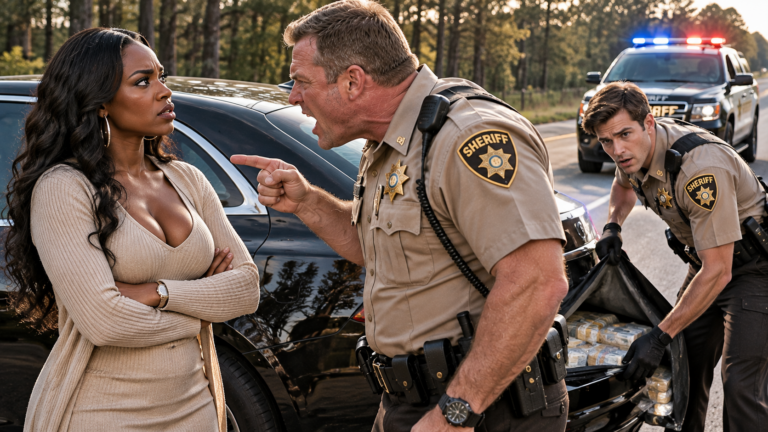
Now he was standing beside a dusty Alabama road, watching a sheriff treat his military identification as worthless.
Chapter 3: The Road Back to Alabama
Isaiah’s father had been born outside Coopersville.
The family moved to Illinois when Isaiah was young, but his grandparents remained in Alabama.
Every summer, Isaiah visited them.
He remembered fishing in small ponds.
Helping his grandfather repair fences.
And sitting on the porch while his grandmother told stories about the family.
When his grandparents passed away, the old family property remained with relatives.
Isaiah hadn’t visited in years.
Military assignments had taken him across the country and overseas.
But retirement finally gave him the opportunity to return.
He planned to spend several days with his aunt, Evelyn Brooks, who was now seventy-three.
She had prepared his favorite meal.
Fried catfish.
Collard greens.
Cornbread.
And peach cobbler.
Isaiah promised to arrive before dinner.
He also had another reason for visiting.
The Coopersville Veterans Resource Center was opening a new employment assistance program.
Its director had invited Isaiah to speak about transitioning from military service to civilian life.
He agreed.
The program was small.
Its budget was limited.
But Isaiah believed it could make a difference.
He wasn’t expecting a ceremony.
He didn’t want special attention.
He simply wanted to help.
His silver Ford F-150 was loaded with luggage, several boxes of books, and personal belongings from his last duty station.
The Illinois plates reflected the state where he had maintained his residence.
He was driving toward Coopersville when the sheriff’s emergency lights appeared in his rearview mirror.
Isaiah checked his speed.
He was below the posted limit.
He carefully pulled onto the shoulder.
And waited.
He assumed the encounter would last only a few minutes.
Chapter 4: The Sheriff Who Made Up His Mind Too Quickly
Arthur Cleary had served as sheriff for almost fourteen years.
Before that, he spent more than a decade as a deputy.
He knew the county roads.
He knew many local families.
And he believed that experience made him a good judge of people.