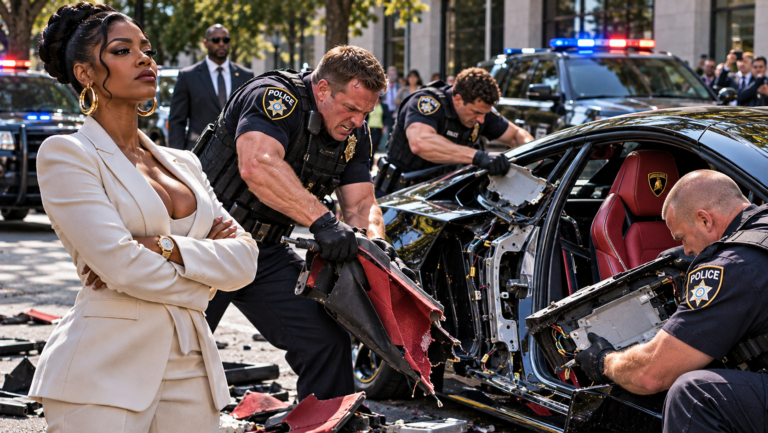
“Because I asked for it.”
“That isn’t a reason, Officer.”
His jaw tightened.
For fifteen years, Ryan had learned that raising his voice usually made people retreat.
Angela didn’t retreat.
Instead, she looked directly at him and asked a question that made him visibly uncomfortable.
“Have I violated any law?”
Ryan glanced around.
A few people had begun watching.
“No, but that doesn’t mean I can’t ask questions.”
“Of course you can. And I can ask why you’re asking them.”
His face reddened.
“Stand up.”
Angela remained seated.
“Officer, I’d like to speak with your supervisor.”
Ryan gave a short, disbelieving laugh.
“Your supervisor?”
“Yes.”
He leaned closer.
“You really think you can tell me how to do my job?”
Angela calmly picked up her coffee.
“No. I think you should know how to do it without treating people like suspects for sitting on a bench.”
Ryan’s expression hardened.
He reached for the radio on his shoulder.
And somewhere across the park, the mayor of Greenhaven was preparing to begin a speech about trust between the community and the police.
Neither man yet understood how quickly that speech would become a test of his own words.
Chapter 2: The Event Built on Broken Promises
Greenhaven Park had not always been a place where residents gathered comfortably.
A decade earlier, the eastern entrance had been poorly lit. A broken playground had remained fenced off for two years, and residents from the surrounding neighborhoods complained that city officials visited only when television cameras followed them.
The lake had eventually been cleaned.
The walking paths had been repaired.
The playground had been rebuilt.
But the memory of neglect had proved harder to remove than the rusted equipment.
People could admire fresh paint without believing their government had changed.
That distance between appearances and trust was why the Safe Streets Open Community event existed.
Each year, the city invited neighborhood associations, youth groups, police officers, public-health workers, transit planners, teachers, and residents to spend a Saturday meeting one another outside the formality of a council chamber.
There were booths where families could request streetlight repairs, tables where teenagers could learn about summer employment, and stations where officers explained traffic-stop procedures and complaint processes.
Children received colored pencils and paper to draw safer streets as they imagined them.
The mayor usually delivered a speech, posed for photographs, and left before the volunteers had finished serving lunch.
This year, however, the event was intended to begin something that would last long after the banners came down.
For eight months, the city had been developing a community trust initiative after public meetings exposed how differently residents experienced the same institutions.
Some people described officers who knew their children by name and helped elderly neighbors carry groceries.
Others described being questioned repeatedly on their own streets, having complaints dismissed without explanation, or being told that asking an officer for identification was disrespectful.
Angela Brooks had helped lead those discussions.
She was not a police officer.
She was not a politician.