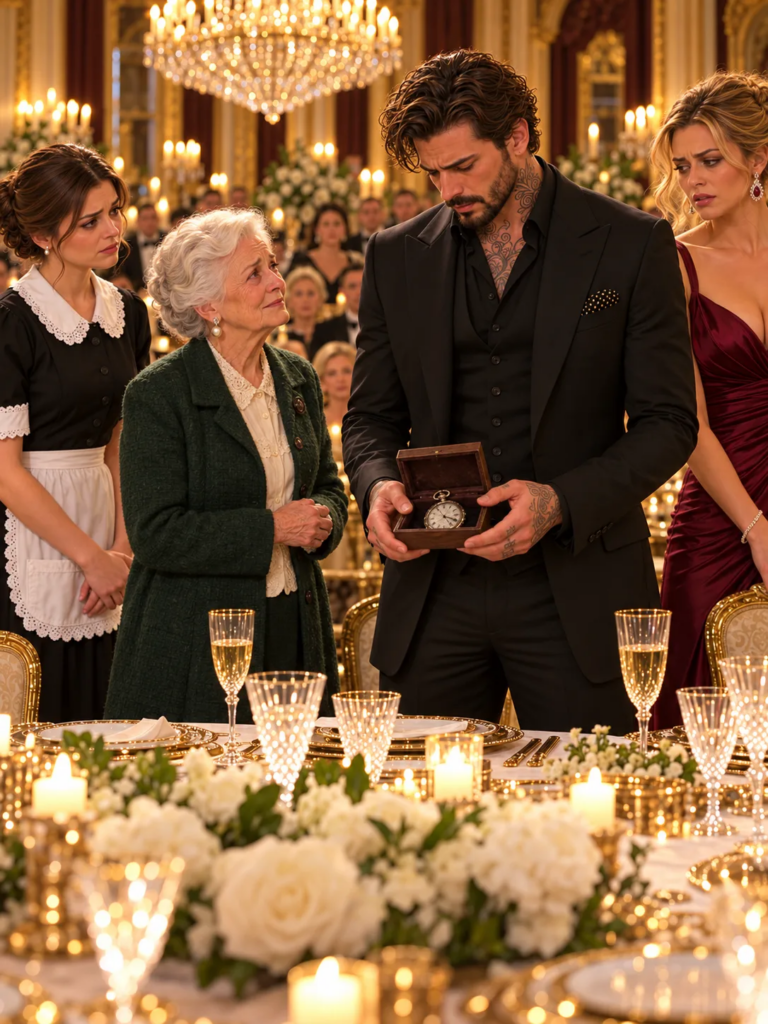
“Don’t take it out.”
Bianca said it too quickly.
Too sharply.
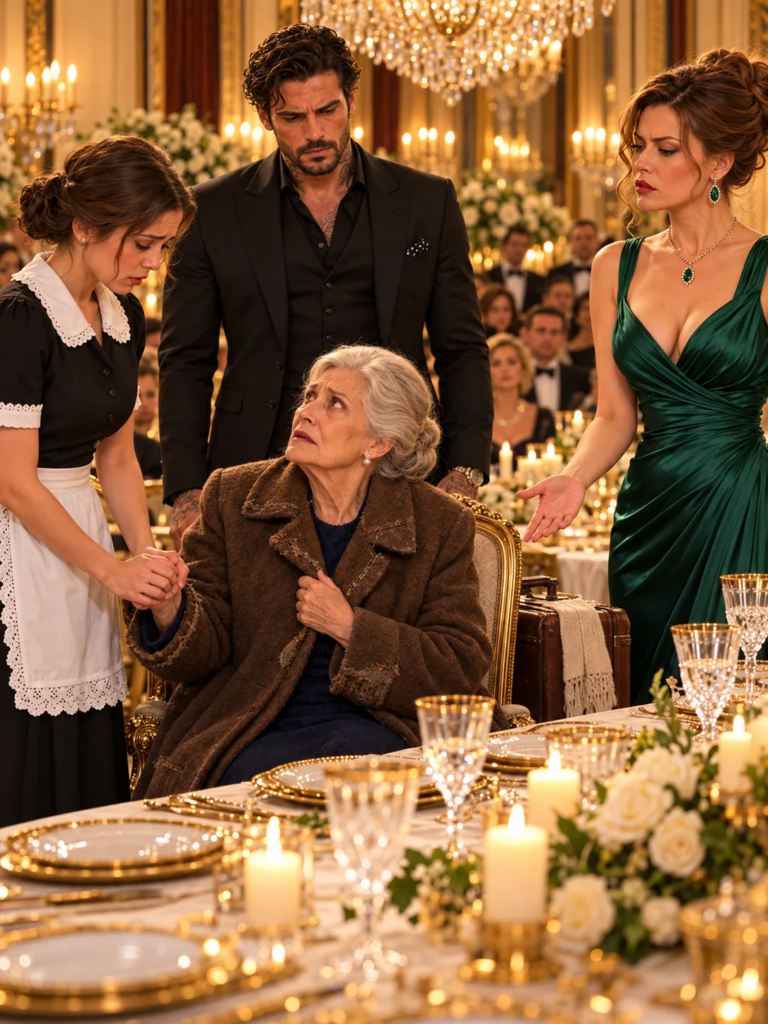
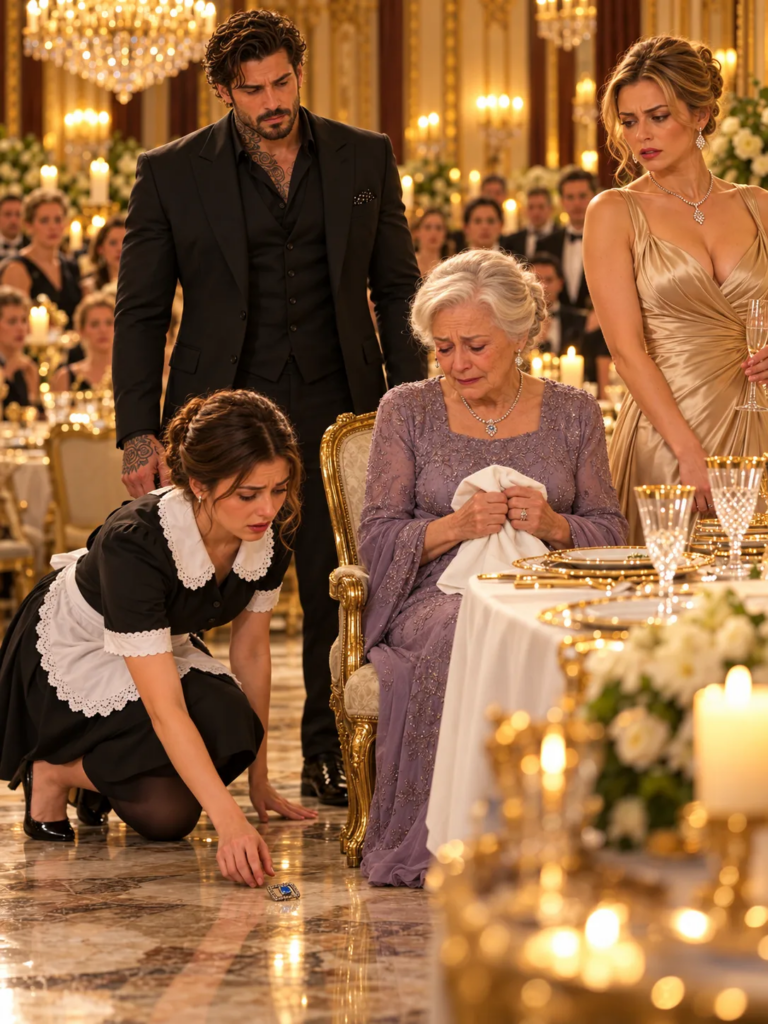
Every head in the ballroom turned toward her.
My fingers closed around the key inside my apron.
Sebastian looked from Bianca to me.
Then his eyes dropped to her hand.
She had reached toward me without seeming to realize it.
“Why?” he asked.
Bianca lowered her arm.
“Because we have no idea what this woman has put into the staff mail. It could be stolen.”
Florence gave a small, tired sigh.
“Twenty-four years, and you people still reach for the same accusation.”
Something moved across Sebastian’s face.
Not recognition.
Something closer to dread.
He turned toward the nearest guard.
“Close the doors.”
The man obeyed.
A soft click sounded behind the last row of guests.
Then Sebastian looked at me.
“What is your name?”
“Ada.”
My voice sounded smaller than I wanted.
“Ada what?”
“Reed.”
Florence closed her eyes.
I saw it.
So did Sebastian.
He turned back to her.
“Miss Flo.”
She opened her eyes again.
“I intended to tell her privately.”
“Tell me what?” I asked.
Nobody answered.
Bianca stepped backward.
Only one step.
But the guard beside the door noticed.
Sebastian did too.
“Stay where you are,” he said.
She lifted her chin.
“You are humiliating me.”
He looked at the ring on her hand.
For several seconds, that was all he did.
Then he said, “I think we’re only beginning to understand that word.”
He asked the guests to leave.
There were murmurs of protest, expressions of concern, people suddenly eager to explain how little they knew about either family.
Sebastian listened to none of it.
He instructed his staff to arrange cars, return coats, and send the unopened wedding gifts back to their owners.
The room emptied in less than fifteen minutes.
I remained beside the dessert cart.
Nobody had told me whether I was free to go.
Florence noticed first.
“She is an employee, Sebastian. Not a piece of evidence.”
He looked at me immediately.
“You may leave.”
I kept my hand in my apron.
“With this?”
His gaze dropped.
Then lifted.
“Yes.”
Bianca made a strangled sound.
Sebastian ignored her.
Florence stepped closer to me.
“Ada, I’m sorry. I should never have sent it without explaining.”
“What is it?”
“A key your mother helped keep safe.”
The ballroom seemed to shift beneath my feet.
“My mother?”
Florence nodded.
I stared at her.
My mother lived in a third-floor apartment in Milwaukee.
She worked four mornings a week at a laundry, watered plants she insisted were doing well despite considerable evidence to the contrary, and never spoke about Chicago.
Not once.
Not when I accepted this job.
Not when I told her the family name.
She had only asked whether the pay arrived on time.
“What does my mother have to do with any of this?”
Florence looked toward Sebastian.
“Her name was Nora Bell before she married.”
Sebastian stopped breathing.
I heard it.
A sudden, complete stillness.
Then he whispered, “Nora.”
I took my hand out of my pocket.
The silver key lay across my palm.
At its head was a small engraved bird.
A swallow.
My mother had drawn that same bird on the inside covers of my schoolbooks.
Every year.
Every single year.
Sebastian looked at it as though I were holding something alive.
“She came back for me,” he said.
I looked up.
“What?”
“Your mother.”
His voice changed.
“She was the one who came back.”
Bianca moved toward the side entrance.
This time, nobody pretended not to notice.
“Bianca,” Sebastian said.
She stopped.
“I’m calling my attorney.”
“Please do.”
“You cannot keep me here.”
“No.”
He stepped away from her path.
“But you will not leave with Florence’s bag, her coat, or anything belonging to my staff.”
Bianca looked down.
Florence’s handbag was on the chair beside her.
Her fingers had already closed around its strap.
Slowly, she released it.
I felt something colder than fear settle inside me.
She had not been improvising.
Whatever she came for, she was still trying to get it.
Sebastian asked me to accompany Florence to the library.
I agreed because Florence looked as though she might fall if she remained standing much longer.
Not because he asked.
I wanted that distinction clear in my own mind.
Inside, he poured Florence water.
His hand was steady.
The glass made a faint sound against the table anyway.
I had worked in that house for seven months.
I had seen him dismiss men twice his age with a glance.
I had seen conversations die when he entered a room.
I had never seen him kneel beside a chair to hear an elderly woman speak.
But that was what he did.
“Tell me,” he said.
Florence rested both hands around the glass.
“Your mother gave me the key three days before the fire.”
The word struck him.
Fire.
I looked between them.
“I thought she drowned.”
“That is what Antonio told people afterward,” Florence said.
Sebastian shook his head.
“No. My father said the fire drove her out through the river entrance. He said the current—”
His voice stopped.
Florence waited until he looked at her again.
“Your mother never reached the river.”
The library was very quiet.
Outside, someone rolled the dessert cart across the ballroom floor.
The tiny rattle of plates sounded unbearably ordinary.
“My mother died in that house?”
“Yes.”
“And he knew?”
Florence’s expression answered before she spoke.
“Yes.”
Sebastian rose.
He crossed to the window.
For several seconds, all I could see was the rigid line of his back.
Then he asked, “Why?”
“I can tell you what I witnessed. The rest is in her papers.”
I looked at the key.
“What papers?”
“Letters. Copies of accounts. A statement she prepared when she decided to leave Antonio.”
“Leave him?” Sebastian turned.
“With you.”
His hand closed against the window ledge.
Florence’s voice trembled for the first time.
“She had arranged a place to stay. She had money of her own. She wanted you somewhere he could not use you.”
I looked at Sebastian.
For a moment, I could see the fifteen-year-old boy he must have been.
A boy who had spent twenty-four years believing his mother had been taken by a river.
“She was coming for me,” he said.
Florence nodded.
“She never stopped trying.”
I stepped into the corridor to call my mother.
She answered on the fifth ring.
“Ada? It’s late.”
“Mom.”
Something in my voice silenced her.
“What happened?”
“Do you know a woman named Florence?”
Nothing.
Then I heard a chair move.
“Where are you?”
“At work.”
“With Florence?”
“Yes.”
My mother breathed out.
It sounded like pain.
“Is she all right?”
“She’s here. She’s tired. Mom, there’s a key.”
The silence that followed was worse.
Finally, she said, “Don’t give it to anyone.”
I looked down at my hand.
“Not even Sebastian?”
Her answer came slowly.
“Especially not before someone independent makes copies of what it opens.”
I leaned against the wall.
“You know him.”
“I knew a boy.”
“He remembers you.”
A small sound reached me.
My mother was crying.
In twenty-seven years, I had heard her cry only twice.
Once when my father died.
Once when she thought I was asleep after we lost our apartment.
“Mom.”
“I’ll come.”
“You don’t have to—”
“Yes,” she said. “I do.”
She arrived the following afternoon carrying an overnight bag with a broken zipper.
Sebastian was waiting in the front hall.
He had sent a car only after she agreed to it.
Even then, she had asked for the driver’s name and insisted I speak to him first.
Now she stood just inside the doorway, looking at a house she had not entered for twenty-four years.
Sebastian took one step toward her.
Then stopped.
“Nora.”
My mother looked up.
His face changed.
I had thought Florence’s story had shaken him.
That was before I watched him recognize the woman who had carried him out of a burning room.
“You had a blue scarf,” he said.
My mother pressed her lips together.
“I wrapped it around your arm.”
“You told me not to look back.”
“You were trying to go upstairs.”
“My mother was upstairs.”
“I know.”
His voice broke.
“You said you’d go.”
My mother’s eyes filled.
“I did.”
He stared at her.
“I went back,” she whispered. “I couldn’t reach her.”
For a long time, nobody moved.
Then Sebastian bowed his head.
My mother set down her bag.
She crossed the hall and put her arms around him.
He was much taller than she was.
It made no difference.
For one brief, terrible moment, he looked like the boy she remembered.
Later, at the library table, my mother explained why she had disappeared.
Antonio Vitale accused her of stealing from his wife.
He claimed she had taken jewelry and money during the fire.
She had been injured, frightened, and without anyone powerful enough to contradict him.
“He told me if I came near Sebastian again, I would be arrested,” she said.
Florence sat beside her.
“He told me Nora had accepted money and left the state.”
My mother looked at her.
“I thought you believed him.”
Florence covered her face.
“Oh, Nora.”
They had each spent twenty-four years believing the other had abandoned them.
Sebastian sat opposite them, listening.
I could tell he wanted to ask questions faster than either could answer.
For once, he forced himself to wait.
“Where did the key come from?” I asked.
“Evelyn,” my mother said.
Sebastian’s mother.
“She kept a document case at an attorney’s office. The silver key opened the case. Access to it required more than the key itself.”
Florence nodded.
“She was careful.”
“Then why did nobody open it?”
“Because her attorney died soon afterward,” Florence said. “His files were transferred. I did not know where. And Antonio spent years making sure I understood what would happen if I searched.”
I looked at her.
“Why now?”
She glanced toward the window.
“Bianca found me.”
Sebastian leaned forward.
“How?”
“I don’t know. She knew about Evelyn. She knew I had worked here. She asked questions that were too specific.”
“And you lied.”
“I told her I had nothing.”
Florence looked at me.
“Then I remembered the girl who helped me when my grocery bag split outside the clinic.”
I remembered that afternoon.
Three months earlier.
An elderly woman, oranges rolling along the sidewalk, a broken handle she kept apologizing for.
I had carried the bags home.
Stayed to fix the loose latch on her kitchen window.
Mentioned where I worked when she asked why I was still wearing an apron beneath my coat.
“You knew who I was?” I asked.
“Not that day. Later, you mentioned your mother’s name.”
Florence looked ashamed.
“I should have spoken sooner.”
“Yes,” I said.
The answer surprised her.
It surprised me too.
But I was tired of people treating delayed truth as though it had arrived on time.
Sebastian found the legal practice that had inherited Evelyn’s attorney’s files.
He did not send men to demand them.
He asked his counsel to establish who was entitled to request access.
My mother insisted on her own attorney.
Florence did too.
I watched Sebastian agree to arrangements that prevented him from controlling the result.
He did not look comfortable.
I did not think he was supposed to.
The case was recovered from secure storage three days later.
It was smaller than I expected.
Brown leather.
A silver lock.
No hidden compartment.
No jewels.
Only papers carefully arranged by a woman who had known she might not be there to explain them.
The attorney examined the authority documents before allowing anything to be opened.
Then he placed the case in the center of the table.
Sebastian looked at the key in my hand.
“Would you?”
I shook my head.
“It was your mother’s.”
He took it.
For the first time since the ballroom, his fingers shook visibly.
The lock opened with a small click.
Inside lay a packet addressed to him.
For Sebastian, when you are safe enough to read this.
He stared at it.
Nobody asked him to hurry.
The first letter was not about money.
It was about him.
His mother had written about his habit of leaving books open facedown.
The horse he refused to admit frightened him.
The afternoon he had pretended not to cry when an injured bird died in his hands.
Your father tells you kindness makes you weak, she had written.
Please do not let grief make him right.
Sebastian covered his eyes.
I looked away.
Not because his grief embarrassed me.
Because, for once, it deserved privacy.
The other papers explained why Evelyn wanted to leave.
She had discovered that money belonging to her family had been redirected through companies Antonio controlled.
Lucien Laurent had helped manage those arrangements.
Bianca’s uncle.
Not her dead father.
Lucien was still very much alive.
The engagement had brought him closer to the records that could expose what he and Antonio had done.
Bianca had not been searching for a keepsake.
She had been searching for the originals.
Among them was a statement Evelyn had signed with her attorney.
It described threats Antonio had made when she refused to surrender control of her remaining property.
There were copies of correspondence.
A proposed separation arrangement.
Instructions protecting money intended for Sebastian.
None of it proved, by itself, what caused the fire.
But it destroyed the story Antonio had told afterward.
Evelyn had not been planning to run away alone.
She had not been unstable.
She had been making careful arrangements to take her son somewhere safe.
And Nora Bell had not stolen from her.
There was a letter for my mother too.
My mother could not open it at first.
She passed it to me.
I read aloud until I reached the sentence that stopped us both.
If Nora has carried out my instructions, she has acted with my full authority. Nothing entrusted to her was stolen.
My mother made a sound I had never heard before.
For years, the accusation had followed her even when nobody else knew about it.
Every employer who asked for references.
Every form asking whether she had left a previous position under difficult circumstances.
Every time I told her she deserved better work and she answered that steady work was enough.
Sebastian looked at her across the table.
“I didn’t know.”
“I know you didn’t.”
“I believed—”
“You were fifteen.”
My mother wiped her face.
“But you’re not fifteen now.”
He nodded.
“No.”
His father agreed to see him the next evening.
Antonio Vitale lived in a guarded house north of the city.
He had retired from daily business years earlier, though people still lowered their voices when they spoke his name.
I was not present for the meeting.
I learned later that Sebastian brought an attorney and a written list of questions.
Antonio dismissed both.
“You’re making a spectacle of yourself.”
Sebastian placed a copy of Evelyn’s letter on the table.
“Did you know Nora went back into the house?”
Antonio barely glanced at it.
“She was paid for her work.”
“Did you know?”
“Yes.”
“Did you accuse her of stealing?”
“She became difficult.”
Sebastian said he had never understood until then how many acts of cruelty could be hidden inside the word difficult.
A woman who asked questions.
A servant who remembered.
A wife who intended to leave.
He asked his father about the threats.
The money.
The false account of Evelyn reaching the river.
Antonio looked irritated.
Not ashamed.
“You were a child. You needed a story you could live with.”
Sebastian remained seated.
“You gave me a story you could live with.”
His father’s expression hardened.
“Everything you have came from me.”
“Not everything.”
He left copies of the questions.
He took the letters with him.
That night, he returned to the mansion without his usual escort.
I was in the kitchen helping my mother make tea.
She had decided the household tea was expensive and disappointing.
She was conducting experiments.
Sebastian stopped in the doorway.
My mother looked up.
“Well?”
He shook his head once.
She nodded as though she understood more than he had said.
Then she reached for another cup.
“Sit.”
He sat.
For several minutes, nobody mentioned Antonio.
My mother complained about the kettle.
I argued that she had overfilled it.
Sebastian watched us.
Then, unexpectedly, he laughed.
It was brief.
Almost disbelieving.
My mother looked at him.
“What?”
“Nothing.”
“Good. Then pass the sugar.”
He did.
Bianca requested a meeting through her attorney two days later.
She wanted to explain.
Sebastian agreed to hear her with counsel present.
Florence chose not to attend.
My mother declined as well.
I had no intention of going until Bianca asked whether I would be there.
That made me reconsider.
Not because I wanted her explanation.
Because I wanted to know why she needed an audience she had spent seven months overlooking.
She arrived in a cream suit without her engagement ring.
She looked tired.
It did not make her harmless.
“My uncle told me Evelyn had taken property belonging to our family,” she said.
Sebastian remained across the table.
“And you believed him.”
“He raised me.”
“So you searched Florence’s apartment?”
“I asked her questions.”
“You threatened her housing.”
Bianca’s eyes flicked toward me.
There it was.
The reason she wanted me present.
“Ada,” she said softly, “you know how elderly people misunderstand things.”
I looked at her.
“No.”
She blinked.
“No?”
“I know Florence remembers exactly what you said.”
Bianca straightened.
“You weren’t there.”
“Then neither of us needs to interpret it for her.”
Sebastian’s attorney returned to the documents.
Bianca’s explanation became less certain as questions grew more specific.
She admitted going through Florence’s drawers while Florence was in another room.
She admitted reporting to Lucien.
She admitted the engagement had given her access she would not otherwise have had.
But she insisted she had grown to love Sebastian.
He listened.
Then he asked, “When were you going to tell me about the key?”
She looked down.
“After the wedding.”
“After you found it.”
Her silence answered.
He took a breath.
“The engagement is over.”
Bianca’s face changed.
For the first time, I saw something beneath the calculation.
Fear.
“If you make an enemy of my uncle—”
“That is a matter for the attorneys and investigators.”
“You don’t understand what he will do.”
Sebastian’s voice stayed level.
“Then give them a statement.”
She stared at him.
He had offered her a door she could not use without admitting she needed one.
I never learned whether she was relieved.
Only that, several weeks later, her attorney began cooperating.
The inquiries that followed did not produce a neat answer to every question.
Some witnesses had died.
Some records were gone.
The cause of the fire had been recorded carelessly, and twenty-four years could not be undone by an unopened case.
But Evelyn’s papers led to other documents.
Financial claims were examined.
False statements were challenged.
Antonio and Lucien had questions to answer that no family dinner could settle.
Sebastian did not ask me to stay in the mansion.
That mattered.
I had begun to notice him in ways that complicated everything.
The way he waited for Florence to finish speaking.
The way he brought my mother a better kettle and accepted her criticism of that one too.
The way he looked at his mother’s handwriting before putting a letter away.
But I still worked in his house.
My wages still came from an account he controlled.
And knowing one part of his history did not make the rest of his life safe.
I gave notice on a Wednesday.
He read the letter in his study.
“Have you found another position?”
“Yes.”
“Where?”
I hesitated.
He saw it.
“You don’t have to tell me.”
“A small hotel downtown.”
He nodded.
“Will they treat you properly?”
“I intend to be very inconvenient if they don’t.”
A faint smile appeared.
“I can imagine.”
I folded my hands.
“Florence can stay until her apartment is ready. My mother wants to go home next week.”
“I know.”
“Then I think everything is arranged.”
He looked at the letter again.
“Except this.”
I said nothing.
After a while, he asked, “Would you let me take you to dinner?”
My heart behaved foolishly.
I wished it had consulted me first.
“Sebastian.”
“I know.”
“You have just ended an engagement.”
“Yes.”
“There are investigations.”
“Yes.”
“And I don’t know enough about the life you still have.”
He put down the letter.
“What would you like to know?”
I looked at him.
“That’s a beginning. It isn’t dinner.”
He nodded slowly.
“All right.”
He did not ask again before I left.
On my last morning, Florence was waiting near the staff entrance.
She handed me a padded envelope.
I stared at it.
“Miss Flo.”
She laughed.
“Open it.”
Inside was a small brass swallow attached to a plain key ring.
No lock.
No inheritance.
No reason for anyone dangerous to search my pockets.
“I thought you should have something that opens only your own front door,” she said.
I hugged her.
She held on tightly.
Behind her, Sebastian stood at the end of the hall.
For once, he seemed unsure whether he was included.
Florence looked over her shoulder.
“Well? She isn’t going to work here forever.”
I laughed.
Sebastian came closer.
“Thank you, Ada.”
I glanced at the old woman beside him.
“I delivered an envelope badly.”
“You asked questions.”
“So did your mother.”
His expression softened.
“Yes.”
I left through the front door.
Not because the staff entrance was shameful.
Because Florence insisted, and nobody in that house had yet learned to win an argument with her.
Six months later, Sebastian called.
He asked whether I had time to speak.
I was in the hotel break room eating an apple over a bin because I had five minutes before the next shift.
“This is glamorous timing,” I told him.
“I can call later.”
“No. What happened?”
“Nothing.”
I leaned back.
It took me a moment to understand that he meant it.
No missing key.
No sudden revelation.
No elderly woman requiring rescue from a Laurent.
He had called because he wanted to hear my voice.
“How is your mother?” he asked.
“Complaining that retirement is expensive.”
“And Florence?”
“You spoke to her yesterday.”
“She told me to stop interfering with her tomato plants.”
“That sounds like her.”
He laughed.
Then he asked about my work.
He remembered that I wanted to move into housekeeping management.
He asked about the course I had started.
He listened when I complained about a guest who used seven towels in one evening and still requested more.
I asked about the investigations.
He answered what he could.
When he could not, he said so.
He did not turn uncertainty into reassurance.
Before we ended the call, he asked once more.
“Dinner?”
I looked down at the brass swallow beside my phone.
“One dinner.”
“Where?”
“Somewhere I can afford half.”
“You don’t have to—”
“Yes,” I said.
A pause.
Then, quietly, “All right.”
We met at a restaurant with paper menus and a coat rack that leaned toward the door.
Sebastian arrived without an entourage.
He looked strangely tall in the small room.
When the waitress asked him to move his chair because he was blocking the aisle, he apologized and moved it.
I watched with considerable interest.
“What?” he asked.
“Nothing.”
“That sounds untrue.”
“It is. I’m enjoying it.”
He smiled.
Not the polite expression I had seen at formal dinners.
Something warmer.
Less practiced.
We talked for nearly two hours.
Not all of it was easy.
I asked him why it had taken a threat to someone he loved before he examined the way people feared his family.
He did not have a satisfying answer.
I respected him more for declining to invent one.
He asked whether I thought people could change.
“Yes,” I said.
He waited.
“I also think the people around them are allowed to take their time believing it.”
He nodded.
After dinner, we walked to the corner where I would catch a cab.
Snow had begun to fall.
A few flakes caught in his dark hair.
He looked up, and for one strange moment I could see the boy Nora had carried out of the fire and the man who had finally listened to her.
Both belonged to him.
Neither explained everything.
“May I see you again?” he asked.
I slipped my hands into my coat pockets.
One closed around the little brass bird.
“Yes.”
His shoulders eased.
“But no surprise cars outside my hotel.”
“No.”
“No asking my manager when I finish.”
“I wouldn’t.”
“And if Florence tells you I like lilies, she’s confusing me with herself.”
He laughed.
“I’ll remember.”
My cab pulled up.
Sebastian opened the door, then stepped aside.
He did not reach for me.
He waited.
So I took his hand.
His fingers closed gently around mine.
I had first noticed him because an entire ballroom was afraid of what he might do.
Standing there in the falling snow, I found myself watching something quieter.
What he was willing to let me choose.
I squeezed his hand once.
Then I got into the cab.
As we pulled away, he remained beneath the restaurant light, snow settling on his coat.
My phone vibrated before we reached the next corner.
A message from my mother.
Well?
I smiled.
He listened.
Three dots appeared.
Then her answer.
Good. Make sure he keeps doing it.
I looked back through the rear window.
Sebastian was still there.
I lifted my hand.
He lifted his.
Then the cab turned, carrying me toward my own apartment, my own work in the morning, and a front door for which only I held the key.