She looked across the audience.
“Technology helped preserve important evidence. But technology alone didn’t solve the problem.”
She paused.
“People still had to make decisions.”
She described the young officer who eventually spoke honestly.
The supervisor who preserved the scene.
The investigators who examined the records.
And the officials who followed the evidence rather than protecting reputations.
Then she added:
“Accountability isn’t created by a camera. A camera records what happened. Accountability begins when people are willing to act on what the evidence shows.”
The audience applauded.
Amara smiled.
She had spent years building a company that protected information.
But the experience had reminded her that integrity was not simply a technical feature.
It was a human responsibility.
Chapter 20: The Third Thing He Couldn’t Take
Late one evening, Amara sat alone in her Manhattan apartment.
The city lights glittered beyond the windows.
On a small table beside her lay a photograph from the day she founded Lattice Integrity.
She was twenty-two in the picture.
Standing beside two colleagues in a tiny office.
Behind them were secondhand desks, tangled computer cables, and a whiteboard covered with handwritten notes.
They had almost no money.
But they had an idea.
A belief that important records should remain trustworthy, even when powerful people wanted them changed.
Amara studied the photograph.
Then she thought about Sergeant Victor Hale.
The officer who threw her handbag onto the pavement.
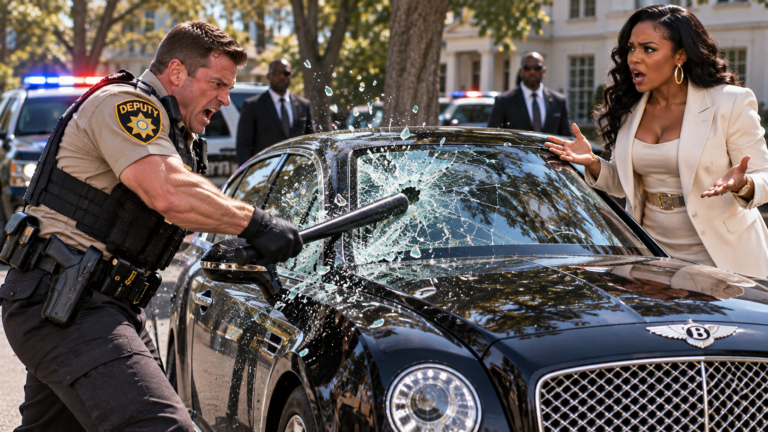
The man who ripped apart the interior of her supercar.
And the supervisor who demanded an electronic device because he believed it contained evidence that could threaten him.
He had been searching for something he could take.
A physical object.
A storage module.
A piece of technology he could hide or destroy.
But he had misunderstood the nature of the evidence.
The records were preserved.
The access history was documented.
The relevant information existed within authorized systems beyond his personal control.
And his own actions had created additional evidence.
Amara leaned back.
The first thing he took was her handbag.
The second was the integrity of her car’s interior.
The third thing he tried to take was the truth.
But the truth was the one thing he couldn’t remove from the scene.
She closed the photograph album.
Outside, Manhattan continued moving.
Cars passed beneath the streetlights.
Office windows glowed across the skyline.
And somewhere in the city, another person was relying on a system to preserve an important record.
Amara knew those systems would never be perfect.
Human judgment could fail.
Technology could be misused.
And powerful people could attempt to manipulate information.
But carefully preserved evidence still mattered.
So did the courage to examine it.
She turned off the light.
And as the city settled into the night, one lesson remained.
Power can damage property. It can threaten people. It can try to conceal mistakes.
But it cannot turn a false story into the truth simply by demanding that everyone believe it.
What Would You Have Done?
Three officers searched Amara Sterling’s million-dollar supercar, damaging its interior while demanding an electronic device. The encounter exposed questions about unauthorized access to confidential records and led to a larger investigation inside the police department.
Do you think Sergeant Hale deserved to lose his job? And should officers who abuse search procedures to obtain sensitive information face stronger consequences?
Share your thoughts in the comments. Real accountability begins when evidence matters more than power.