The department acknowledged that the incident had damaged public trust.
It also recognized that accountability required more than removing one employee.
The underlying weaknesses needed to be addressed.
Amara’s supercar was examined and repaired.
The damaged leather panels were replaced.
The vehicle’s electronics were checked by authorized technicians.
And the company responsible for the repairs documented the full cost.
But Amara did not consider the money her greatest concern.
She had built Lattice Integrity to protect the reliability of important information.
Now she had seen how far someone might go to prevent that information from being examined.
The incident reinforced her belief that trustworthy systems needed both technical safeguards and human accountability.
Neither could replace the other.
Chapter 18: The CEO Who Refused to Be Defined by the Damage
Months later, Amara returned to the same Manhattan neighborhood for a business meeting.
This time, she arrived in a simple black sedan driven by a professional chauffeur.
The streets were busy.
Yellow taxis passed through the intersection.
Pedestrians hurried along the sidewalks.
And the tall office buildings reflected the afternoon sun.
Amara looked toward the location where the officers had searched her supercar.
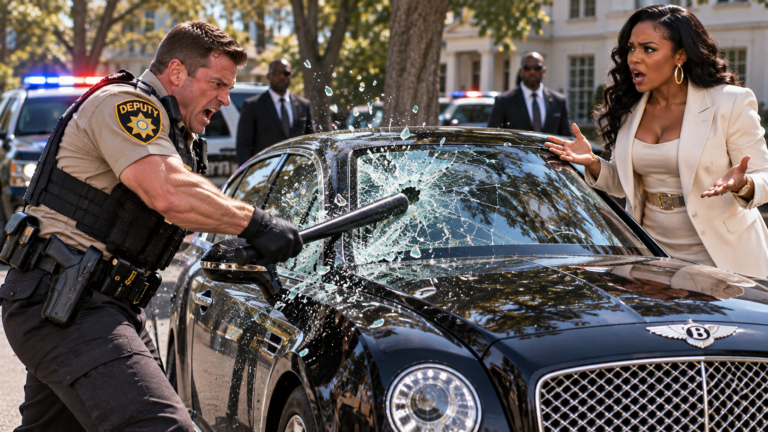
She remembered the handbag striking the pavement.
The leather panel being ripped loose.
The furious shouting.
And Hale demanding evidence he had no lawful basis to seize.
For a moment, she felt the anger return.
Then she took a slow breath.
The investigation had been difficult.
Her company had spent substantial time cooperating with investigators.
She had endured public attention she never wanted.
And the damaged vehicle had become a symbol of something far more serious.
But the evidence had survived.
The truth had not disappeared.
And the systems her team built had helped investigators establish a reliable record of what occurred.
She thought about her father.
The man who taught her that technology mattered only when it helped people trust what they were seeing.
He would have understood why the case mattered.
Not because his daughter owned a million-dollar supercar.
Not because her company was worth billions.
And not because the officers had failed to recognize her.
But because someone had tried to replace facts with intimidation.
And the evidence had resisted.
Amara smiled faintly.
She had watched the officers tear apart her vehicle without revealing everything she knew.
She had allowed the proper authorities to investigate.
And she had trusted that carefully preserved records would speak louder than threats.
Chapter 19: The Lesson Behind the Supercar
One year after the incident, Amara addressed a technology and public accountability conference.
The audience included engineers, legal professionals, cybersecurity specialists, and public officials.
She spoke about digital evidence preservation.
The importance of audit trails.
And the need for systems that could detect unauthorized access.
Then a member of the audience asked about the police encounter.
“Ms. Sterling, what was the hardest part of that experience?”
Amara paused.
“The hardest part wasn’t watching my car being damaged.”
The room became quiet.
“It was realizing that someone with official authority believed he could destroy property and intimidate a person because he assumed the truth was something he controlled.”