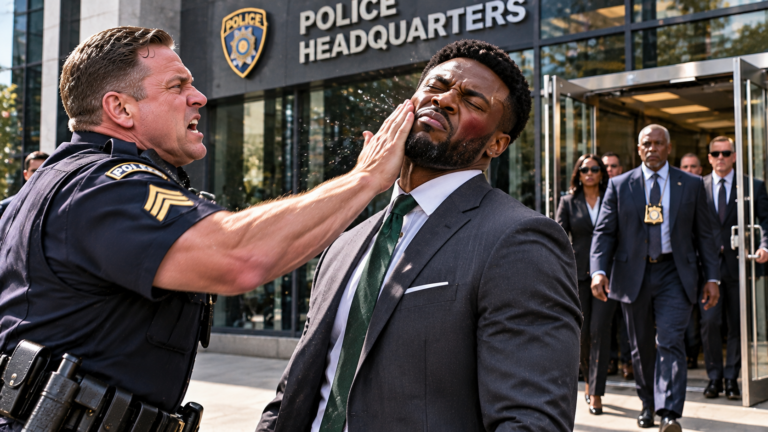
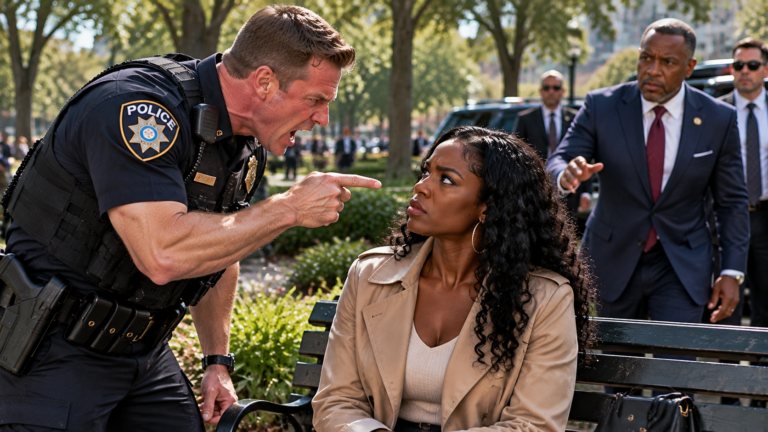
He looked toward the county officials.
“A few months ago, I asked questions about a neighbor’s towing fees.”
He paused.
“I didn’t accuse anyone of a crime. I asked for the records to be reviewed.”
The room remained silent.
“Then a police sergeant came to my house and accused me of stealing county property.”
Samuel swallowed.
“He pushed me against his patrol vehicle while I begged him to stop.”
Andre lowered his eyes.
Samuel continued.
“My son found video showing that the property had been placed in my truck before the accusation.”
He looked across the audience.
“I don’t want anyone to suffer because of this.”
His voice grew steadier.
“But I do want people to understand something.”
The room was completely silent.
“A citizen should be able to ask a question without being afraid of what might happen next.”
Applause began near the back.
Then spread across the room.
Samuel folded the paper.
And for the first time since the incident, he felt that his voice had been heard.
Chapter 16: The Department’s Decision
The independent investigation continued for several months.
Its findings established serious misconduct in Baird’s handling of the encounter with Samuel.
The review concluded that he had used unjustified force and made statements inconsistent with the available evidence.
It also identified substantial concerns about the alleged stolen property and the circumstances surrounding the toolbox’s placement in the pickup.
Baird was dismissed from the department following the disciplinary process.
The evidence relating to possible criminal offenses was referred to independent prosecutors for review.
The county separately examined its towing contracts and oversight procedures.
Several contracts were suspended or revised while concerns were addressed.
New requirements were introduced for documenting impound decisions and reviewing complaints.
The sheriff’s office also strengthened policies concerning interactions with elderly residents and people experiencing medical distress.
Officers received updated instruction on de-escalation, evidence preservation, and the responsibility to intervene when a colleague used unnecessary force.
Elise Navarro remained with the department.
Her accurate account of the encounter and decision to request supervisory assistance were recognized as important.
Andre continued cooperating with investigators through the appropriate process.
Samuel’s legal representatives pursued available remedies for the injuries and distress he experienced.
But Samuel did not celebrate the disciplinary outcome.
He had never wanted to become the center of a public controversy.
He wanted to live peacefully in the home he had shared with Evelyn.
And he wanted to know that the next person who questioned an officer would not be treated the way he had been.
Chapter 17: The Deputy Who Chose Her Conscience
Several months later, Elise Navarro was invited to speak during a training session for younger deputies.
She was nervous.
She had never considered herself particularly brave.
But she agreed.
The instructor asked her to discuss the importance of intervening when a colleague’s conduct appeared inappropriate.
Elise stood before the room.
She described the difficulties of challenging a supervisor.
She explained that officers sometimes felt pressure to support colleagues even when they were uncomfortable.
Then she spoke about Samuel Bennett.
She did not focus on the investigation’s confidential details.