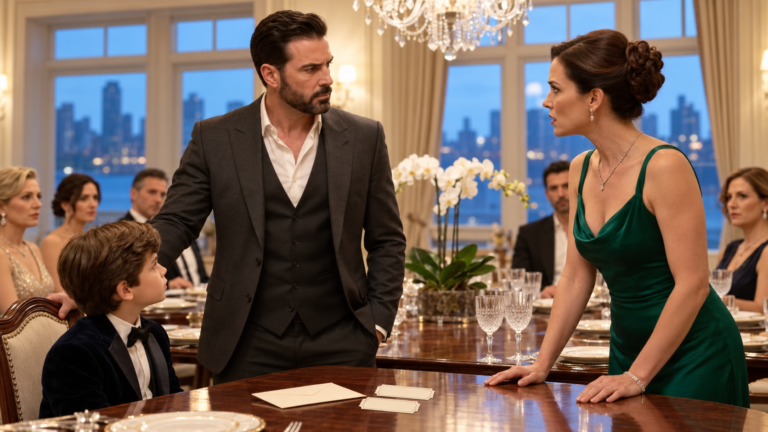
Vincent looked at her.
“We’re not discussing this over him.”
“You’re the one asking questions.”
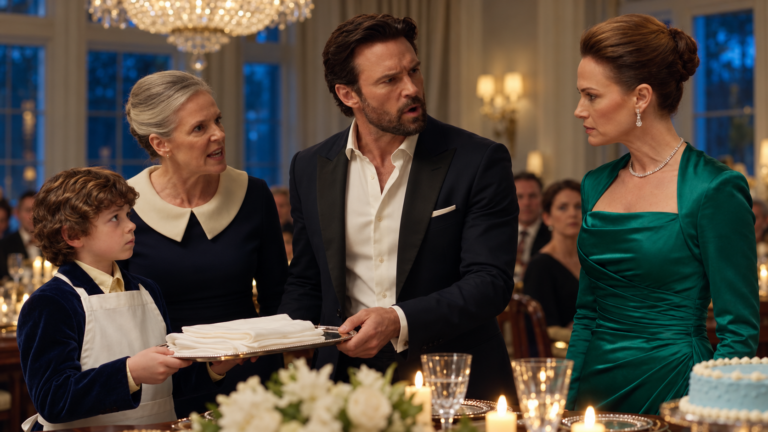
“June, would you take Oliver into the breakfast room? I’ll come with you.”
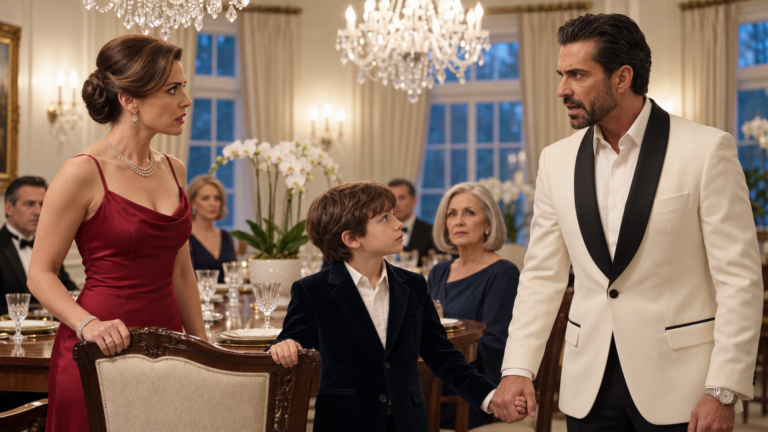
The boy immediately caught his wrist.
“Not the car?”
“No car.”
“Because my shoes—”
“We can leave them where they are.”
Oliver looked at the hall.
Then at the six relatives.
His uncle began to say something about nobody intending to upset him.
Vincent stopped him.
“Give us a minute.”
I carried the cake.
Oliver carried the card.
His father walked beside him, one hand available without pulling.
At the breakfast-room door, the boy finally took it.
Oliver’s mother was alive.
That is worth saying because later, as the adults tried to explain how things had gone so wrong, some spoke as though Camille had been the only other person responsible for him.
She wasn’t.
Maren lived forty minutes away.
Oliver stayed with her on alternate weekends and one school night each week.
His parents had separated two years earlier.
They didn’t always agree.
But they both knew their son stuttered.
They both knew his speech therapist’s name.
They both knew that a difficult speaking moment did not mean he hadn’t learned the words.
Maren knew nothing about a visit to Judith’s house.
I knew that because I had spoken to her that afternoon about a missing library book.
Oliver knew it too.
In the breakfast room, his first question was:
“Does Mum think I’m coming?”
Vincent pulled out a chair.
“No one has told me she does.”
“Can we ask?”
“Yes.”
“Now?”
“Yes.”
He took out his phone.
Then he looked at the folded card.
“Would you like to put that somewhere safe?”
Oliver pressed it against his chest.
“It’s yours.”
“May I read it?”
The little boy hesitated.
Then handed it over.
Inside was a drawing of two people beneath a dark blue sky.
One held a telescope.