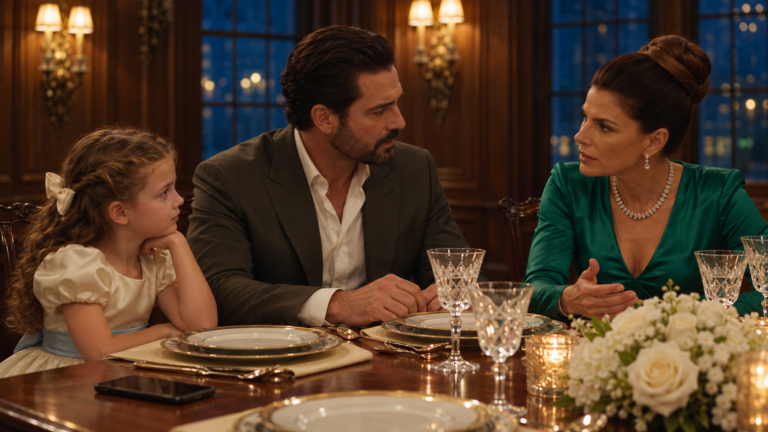
We cleared the table.
She remained annoyed.
I remained her father.
We ate.
The food wasn’t a prize for successful tidying.
The tidying wasn’t an apology for existing inconveniently.
They were separate parts of an ordinary evening.
I had not realized how often adults joined unrelated things simply because it gave them leverage.
I was learning to stop.
The most difficult change was not a new rule.
It was learning to remain in the room when my daughter was unhappy without treating her unhappiness as a problem I needed to defeat.
I was accustomed to solutions.
A call.
A decision.
Someone instructed to make the difficulty disappear.
Evie needed something less efficient.
One afternoon, she cried because a drawing of Mina didn’t look right.
I offered another sheet.
She refused.
Different pencils.
No.
A break.
No.
I began to feel the familiar impatience.
Then she said:
“You keep trying to make it stop.”
I looked at her.
“The picture?”
“The sad.”
I put down the pencils.
She was right.
I sat beside her.
For a while, we did nothing.
Then she leaned against my arm.
Later, she chose another sheet herself.
The drawing still wasn’t perfect.
She kept it.
I understood something that afternoon I wished I had known sooner.
Helping did not always mean removing the feeling.
Sometimes it meant refusing to remove the person having it.
Daphne eventually acknowledged that taking the meals away had been wrong.
She said it during a meeting with the counselor.
Not as the beginning of another argument about Evie’s behavior.
A complete sentence.
I listened.
I was glad she said it.
It did not settle the marriage.
There were questions about trust.