Her friend had given her a purple bracelet.
Evie pulled it from her pocket.
“She made mine longer.”
“Why?”
“Because I don’t like it tight.”
I looked at the little beads.
One was shaped like a star.
“She remembered.”
Evie nodded.
Then her eyes filled again.
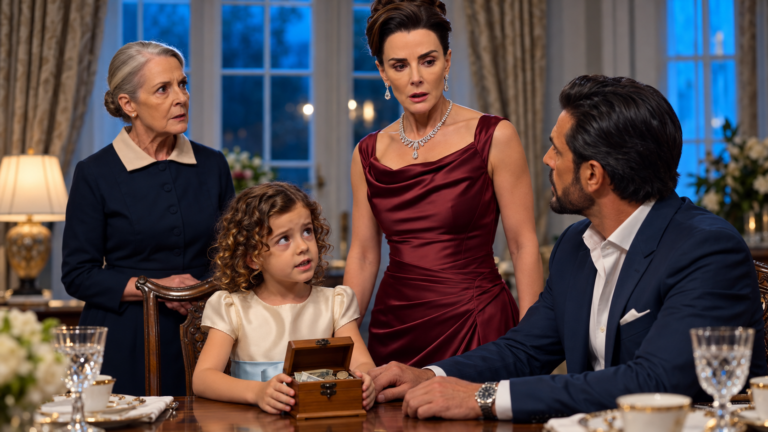
She stopped chewing.
Her hand moved toward the edge of the plate.
I understood.
“You can be sad and eat.”
She looked at me.
“But it starts again.”
“The crying?”
A nod.
“That’s all right.”
She watched me for a moment.
Then took another bite.
Ruth asked whether Mina had arrived at her new house yet.
Evie didn’t know.
We could ask her mother later.
The conversation continued.
A child’s sadness.
An ordinary meal.
No audience.
No test of whether she had become pleasant enough to deserve another mouthful.
The tears came twice.
Both times, the plate remained.
I noticed her checking.
I wished I had understood earlier that a child can learn the rules of a frightening house by watching objects.
A door.
A chair.
A plate moving away.
She had been reading the table more carefully than I read my own household.
When she finished, I asked whether she wanted more.
Evie looked at Ruth.
The nanny nodded gently.
“You can ask.”
“Even bread?”
“Even bread.”
She chose half a roll.
Then asked whether she had to finish everything.
“No,” I said.
“What if I can’t?”
“You can stop when you’ve had enough.”
Daphne had sometimes described Evie as wasteful.